Sunday, 24 May 2020

Cromford Canal - 21st May 2020

Jayne and I had a walk along Cromford Canal on Thursday. We started off at the Wharf and walked towards Ambergate for about 2 and a half miles.

As always, we had great views of Little Grebe on the canal, including one pair with a tiny "humbug" chick. Moorhens had chicks (5), as did Mallard (2 broods) and Canada Geese (4 goslings). Warblers were in good voice with Chiffchaff, Blackcap and Garden Warbler heard. The Garden Warbler was singing from the top of a tree, so we actually got to see it! A single Pied Flycatcher was heard singing from the woodlands. We also spotted a shrew species running along the tow path. Unfortunately, it disappeared into the vegetation by the canal before we got good views, but it could have been a Water Shrew.

Little Grebe and chick

Garden Warbler

Canada Geese goslings

Once the sun came out, damselflies started to appear, with Large Red Damselflies and Azure Damselflies being the most common species. The highlight, however, was a stunning male Banded Demoiselle, my first sighting of 2020, that Jayne spotted just beyond the Derbyshire Wildlife Trust's Lea Wood Nature Reserve. It was being "buzzed" by the Azures, and I managed to catch this lovely photo with all 4 wings on show.

Banded Demoiselle.

Thursday, 21 May 2020

Deep Dale - 19th May 2020

Jayne and I had a few hours walking in the Plantlife reserve in Deep Dale on Tuesday. We go most years to see the orchids and Cowslips. This year, due to the lockdown, we were a little late for the flowers, but we did manage to see some of the other specialities of this reserve.

First up was the Green Hairstreak butterflies. We saw 3 whilst on site. We also spotted a new species for us at Deep Dale, the Dingy Skipper. Again, we managed to see three different individuals. Other butterflies seen were: Wall Brown (1), another new species for us here, Orange Tip (2 males) and Large White (1).

Green Hairstreak

Dingy Skipper (and friend!)

Birdwise it was quite quiet, but we did get great views of a female Redstart, and heard Blackcaps, Willow Warblers and Chiffchaffs.

Wednesday, 20 May 2020

Seymour Ponds - 18th May 2020

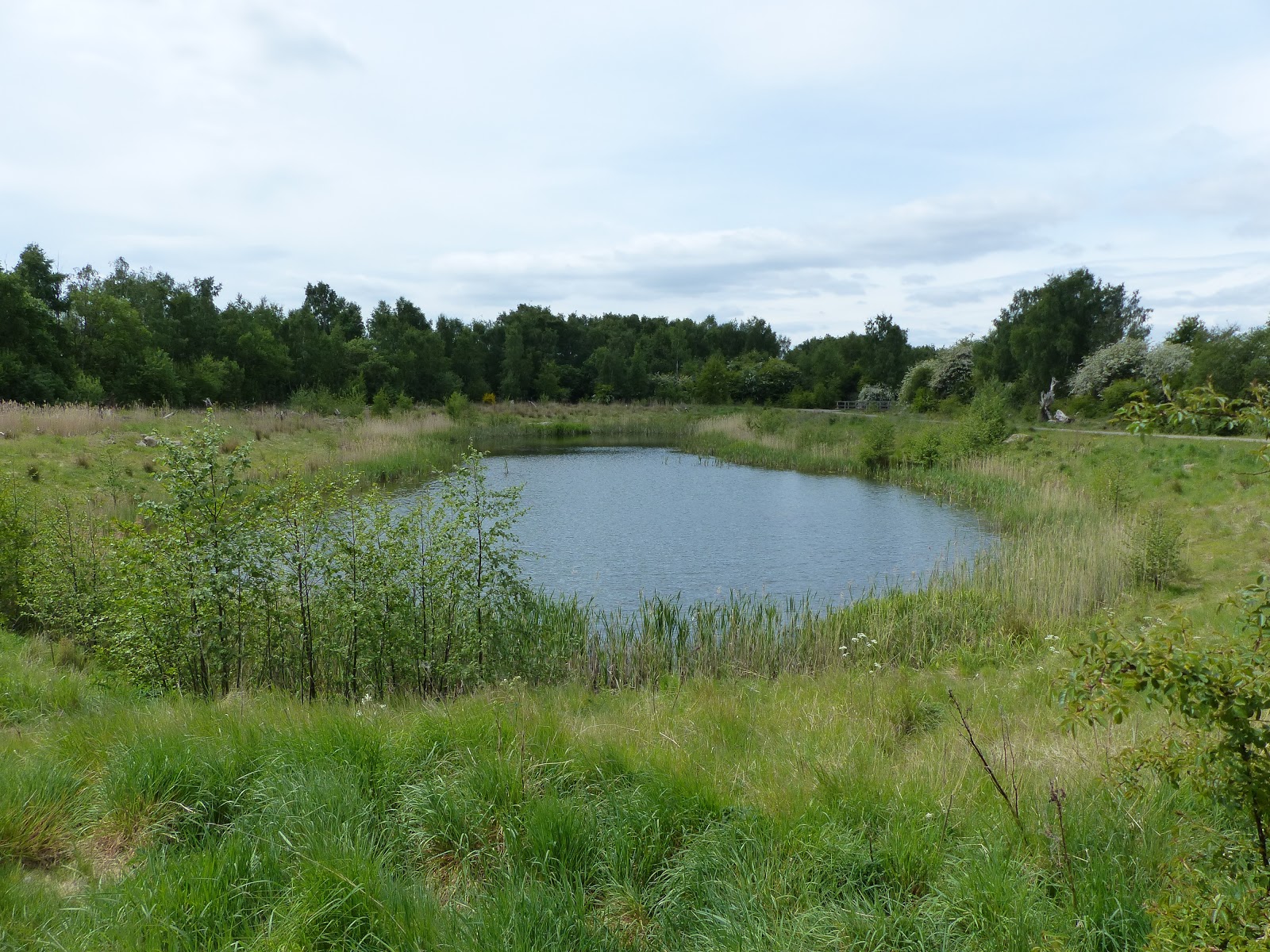
On Monday, I visited a set of ponds called Markham Vale or Seymour Ponds in Staveley, Chesterfield. It was my first visit to this site, after spotting a Facebook post about the presence of Hairy Dragonflies there. Unfortunately, I didn't manage to spot any, but I did find an excellent site for dragonflies, damselflies and other insects.

1 of the 4 ponds on site

The first species spotted was Large Red Damselfly. This species was very common, with 30+ individuals seen, including many pairs "in tandem". Blue-tailed Damselflies were also present and mating, whilst 1 male Azure Damselfly was also seen.

Whilst on site, I spotted 2 species of dragonfly, namely Four-spotted Chaser and Broad-bodied Chaser. The "Four spots", at least 10 individuals, were all newly emerged and hanging around in the long grasses around the ponds. The Broad-bodied Chasers, 1 male and 1 female, were also newly emerged and also "warming up".

Four-spotted Chaser

Other insects seen included: Small Heath (very common, 30+), Peacock (1), Common Blue Butterfly (3+ males and at least 1 female), Mother Shipton moth (3 individuals), a Thick- or Swollen-thighed Beetle and a stunning Spiny Mason Wasp, Odynerus spinipes.

Mother Shipton moth

Swollen-thighed Beetle

Spiny Mason Wasp

I spoke to another photographer whilst there, and he mentioned there being Dingy Skippers and Brown Argus butterflies on site as well. I didn't see either species on my visit, but it will definitely be worth another trip here, later in the year, to try and catch up with them, along with some of the other summer-flying insects.

Bird wise it was quite quiet, but I did see and hear Reed and Sedge Warblers (year ticks), as well as Swifts (5), Swallows (1), Skylark, Chiffchaff, Blackcap, Willow Warbler ( all heard singing) and Common Buzzard (1).

UPDATE: I returned to this site today (21st May) in much sunnier weather, and managed to spot 2 Hairy Dragonflies. LIFER!!! I got great views as they flew around two of the ponds, chasing the Four-spotted Chasers. Unfortunately no photos, as they never stood still, so here's a link to see what one looks like.

Tuesday, 19 May 2020

Starling Nest Update - 19th May 2020

It seems like quite a while ago since I last blogged about the Starling nest that is in a box on the side of my house, and that I am monitoring for the BTO's Nesting Neighbours scheme. In my last post (here) 4 chicks, from 5 eggs, had just hatched (Monday 27th April). Since then, the adults have done a fantastic job and have raised all 4 chicks to the point of fledging. 2 fledged yesterday, and the last two fledged today. Before fledging I ringed all four chicks, under BTO license, so hopefully I'll get a report of at least one of them.

4 chicks ready to fledge

Linacre Nestboxes, Birds and Insects

I was able to get down to Linacre on Saturday to check the nestboxes for the first time this season. I walked around all three reservoirs and checked 87 boxes. In total, I found 37 boxes with active nests in them; 33 were either Blue or Great Tits, but there were also 2 Pied Flycatcher nests, 1 Wren nest and 1 Nuthatch nest. There were also 3 singing Pied Flycatchers, which is the highest count I've had, since the first ones were recorded in 2008. All nests are being monitored for the BTO's Nest Record Scheme.

Whilst on site, I also had a look for any insects that were active. I didn't see any butterflies, but I did spot this adult Cinnabar Moth that was emerging on a fence and a Scorpion Fly.

Cinnabar Moth

I also managed to see the first ducklings of the year. There were two broods of Mandarin Duck, 7 and 4, and one brood of Mallard with 3 ducklings.

The best sighting, however, was my first ever sighting of a Grass Snake. I spotted one basking on a stone wall by the bottom reservoir. Unfortunately, I only managed a quick photo before it slid off, into the wall. I did, however, manage to spot a "sloughed" skin in the same spot.

Spot the snake!!

Friday, 15 May 2020

Year List Update - 15th May 2020

I last updated my year list back in February (see here). At the time, I had recorded 91 species in the UK, and was looking forward to an Easter trip to Majorca!! Obviously, due to the Corona Virus lockdown, the trip was cancelled, as was all other, non-essential travel, and opportunities to see some of my usual spring birds didn't happen.

Having said that, the list has continued to increase, with birds seen over the garden, or on our daily exercise walks, and it now stands at a not- too-terrible 108 species.

Year List update:
92 – Yellowhammer
93 – Chiffchaff
94 – Whooper Swan
95 – Dipper
96 – Skylark
97 - Blackcap
98 – Willow Warbler
99 – Raven
100 – Linnet
101 - Swallow
102 – House Martin
103 – Whitethroat
104 – Garden Warbler
105 – Swift
106 – Pied Flycatcher
107 – Meadow Pipit
108 – Cuckoo (heard)

Birds 92 - 105 were all first recorded in Dronfield and the surrounding area, with the exception of the Whooper Swan, which was a late addition, having been seen over Linacre on 21st March (my last visit before lockdown). Willow Warbler was first recorded in the garden, my first ever garden sighting! Numbers 106 - 108 were seen yesterday, by Jayne and me, on our first car trip since March, when we had an hour at Padley Gorge (4pm - 5.00pm).

Garden Moths - An Update

I first blogged about my garden moths a few weeks ago (see here). Since then, I've had the trap out  another 5 times, and have increased the garden list for 2020 to 23 species. Nothing rare yet (as expected), but the following species have been recorded (alphabetical order): Bee Moth, Brindled Pug, Brown House-moth, Common Marbled Carpet, Common Plume, Common Pug, Common Quaker, Double Striped Pug, Early Grey, Flame Shoulder, Garden Carpet, Grey Pine Carpet, Heart and Dart, Light Brown Apple Moth, Pale Tussock, Pine Beauty, Purple Thorn, Scalloped Hazel, Small Quaker, Streamer, Tachystola acroxantha, Waved Umber and White-shouldered House-moth! In addition to these species, I also identified a moth that I photographed in Warkworth, Northumberland, last May, as a Common Swift.

Here are a few photos of the more photogenic species!!

Early Grey

Pale Tussock

Streamer

The weather is set to be warmer over the weekend again, so I'll have the trap out, and hopefully add a few more species to the "garden list". Hawkmoth species perhaps??