I was out ringing at Linacre yesterday with Sorby Breck Ringing Group. This was our first session since the start of August, and we were on site from 06.30 to 10.30, catching a very nice 76 birds, including 2 warbler species and a species that we've only ringed twice at Linacre, once in 2012 and again in 2014. Can you guess what it was??
.
Totals for the morning were new/retrap: Blue Tit 12/4, Great Tit 10/5, Coal Tit 2/0, Long-tailed Tit 1/0, Dunnock 1/0, Robin 4/0, Blackbird 1/0, Blackcap 1/0, Chiffchaff 9/0, Goldcrest 15/1, Meadow Pipit 1/0, Nuthatch 1/0 and Goldfinch 8/0.
As you can see, the two warbler species were Chiffchaff and Blackcap. All birds were aged as 3s (born this year). The other highlight was the single Meadow Pipit, also a bird born this year. This species is heard most years passing over the site, and we have managed to entice a few birds down in 2012 and 2014, so to catch one this weekend was very nice.
Other species seen between net rounds included a very impressive flock of c.50 House Martins (the biggest count of the year by a very long way), that were feeding over the ringing site, 5 Swallows, 1 Buzzard and a Sparrowhawk.

Welcome to my blog all about my birdwatching, wild bird ringing activities and moth recording at Linacre Reservoirs, Derbyshire; in Great Britain and abroad.
Sunday, 24 September 2017


Friday, 1 September 2017
Linacre- 1st September 2017
The sun was out this morning, so I decided to have a few hours down at Linacre. There were 6 species of butterfly on the wing, 3 dragonflies and 1 damselfly species.
The butterflies seen were: Speckled Wood (5), Peacock (5), Red Admiral (2), Large White (1), Comma (1) and Small Copper (3, my first record of 2017).


The butterflies seen were: Speckled Wood (5), Peacock (5), Red Admiral (2), Large White (1), Comma (1) and Small Copper (3, my first record of 2017).

Small Copper
Dragonflies and damselflies seen were: Common Dater (1, the first Linacre record of 2017), Brown Hawker (3), Southern Hawker (1) and Common Blue Damselfly. 2 species of hoverfly were also seen: Volucella pellucens (Great Pied Hoverfly) and Sericomyia silentis (only my second Linacre record, after 1 on 18th August 2016).

Sericomyia silentis
Birds seen around the site today were: Mallard (37), Tufted Duck 19; 18 adults and 1 duckling), Mandarin Duck (25), Great-crested Grebe (2 adults and 1 juvenile), Grey Heron (2), Grey Wagtail (1), Coot (3 adults), Moorhen (12; 6 adults and 6 juveniles), Cormorant (1), Common Buzzard (1), Swallow (c. 15) and Chiffchaff (3, including 1 singing).
Wednesday, 16 August 2017
Dragonfly and Butterfly News
Over the summer period I like to get out and about recording dragonflies, damselflies and butterflies. Recently I've added a few new species.
The first new insects were spotted last week on a walk around Cupola Ponds, Stanedge. Emerald Damselflies were very common here, along with several Common Blue Damselflies, several Common and Brown Hawkers and an Emperor dragonfly.

Afterwards, I drove up to Big Moor, where, again, many Emerald Damselflies were flying about, including several pairs "in cop" i.e. mating. Also seen here were Common Darter (pairs in cop and newly emerged individuals), Common Hawker and a very nice Wall Brown butterfly.

The last new species were Ruddy Darter and Black Darter. The Ruddy Darter, a male, was seen on Monday at RSPB Old Moor, and the Black Darter, males, females and newly emerged, (tenerals) were seen at Little Barbrook Reservoir on Big Moor.


The first new insects were spotted last week on a walk around Cupola Ponds, Stanedge. Emerald Damselflies were very common here, along with several Common Blue Damselflies, several Common and Brown Hawkers and an Emperor dragonfly.

Emerald Damselfly (male)
Afterwards, I drove up to Big Moor, where, again, many Emerald Damselflies were flying about, including several pairs "in cop" i.e. mating. Also seen here were Common Darter (pairs in cop and newly emerged individuals), Common Hawker and a very nice Wall Brown butterfly.

Emerald Damselflies (mating pair)
The last new species were Ruddy Darter and Black Darter. The Ruddy Darter, a male, was seen on Monday at RSPB Old Moor, and the Black Darter, males, females and newly emerged, (tenerals) were seen at Little Barbrook Reservoir on Big Moor.

Ruddy Darter (male)

Black Darter (female, I think)

Black Darter (male)
Tuesday, 15 August 2017
Year List Update - 15th August 2017
I haven't updated the "year list" for the last 2 weeks, despite seeing a few new species.
The first one to add to the list is a great species that I don't see every year; Chough. Jayne and I had a walk along the clifftop at the National Trust's Kynance Cove on the last day of our holiday, where we managed to spot a family party of 4 birds. Views were brief , and I didn't manage to get a photo, so instead, here's one that my nephew, Luke, got on a recent trip the RSPB South Stack on Anglesey.

The next bird; Water Rail, was added when I heard one whilst ringing at Poolsbrook Marsh. The next 3 species; Wood and Green Sandpiper and Greenshank, were all seen yesterday at RSPB Old Moor. The final species; Whinchat, was a juvenile bird seen today on Big Moor.
Year List update:
179 – Chough
180 – Water Rail (heard)
181 – Wood Sandpiper
182 – Green Sandpiper
183 – Greenshank
184 – Whinchat
The first one to add to the list is a great species that I don't see every year; Chough. Jayne and I had a walk along the clifftop at the National Trust's Kynance Cove on the last day of our holiday, where we managed to spot a family party of 4 birds. Views were brief , and I didn't manage to get a photo, so instead, here's one that my nephew, Luke, got on a recent trip the RSPB South Stack on Anglesey.

Chough
The next bird; Water Rail, was added when I heard one whilst ringing at Poolsbrook Marsh. The next 3 species; Wood and Green Sandpiper and Greenshank, were all seen yesterday at RSPB Old Moor. The final species; Whinchat, was a juvenile bird seen today on Big Moor.
Year List update:
179 – Chough
180 – Water Rail (heard)
181 – Wood Sandpiper
182 – Green Sandpiper
183 – Greenshank
184 – Whinchat
Sunday, 13 August 2017
Mute Swan Ringing
Last year I became aware that one of Sorby Breck Ringing Group's members was the founder of the Yorkshire Swan Rescue Hospital. I also found out that he rings Mute Swan in and around Yorkshire and Derbyshire. Unfortunately I couldn't get out with him this year, so, when I saw the dates for swan ringing this year, I decided to meet up, and have a very different ringing experience.
I met up on Friday (11th) with 7 other members of the group and spent the whole day travelling around Yorkshire. We visited several sites where there were either pairs with cygnets, or, as in the case of Lakeside, Doncaster, where there was a large herd of mainly non-breeding birds. By the end of the day we'd ringed an amazing total of 58 Mute Swans, and re-sighted approximately 25 other birds that had been previously ringed by the group.
Birds were aged, sexed and a moult score was taken. A BTO metal ring, and a coloured darvic ring were also fitted by the licensed ringers, and the birds were then given a general health check by members of the Swan Rescue Group before being released back onto the water as a family group. Footage of the release of a family in Goole Docks can be seen here on the Group's Facebook page.


I met up on Friday (11th) with 7 other members of the group and spent the whole day travelling around Yorkshire. We visited several sites where there were either pairs with cygnets, or, as in the case of Lakeside, Doncaster, where there was a large herd of mainly non-breeding birds. By the end of the day we'd ringed an amazing total of 58 Mute Swans, and re-sighted approximately 25 other birds that had been previously ringed by the group.
Birds were aged, sexed and a moult score was taken. A BTO metal ring, and a coloured darvic ring were also fitted by the licensed ringers, and the birds were then given a general health check by members of the Swan Rescue Group before being released back onto the water as a family group. Footage of the release of a family in Goole Docks can be seen here on the Group's Facebook page.

BTO ring being fitted
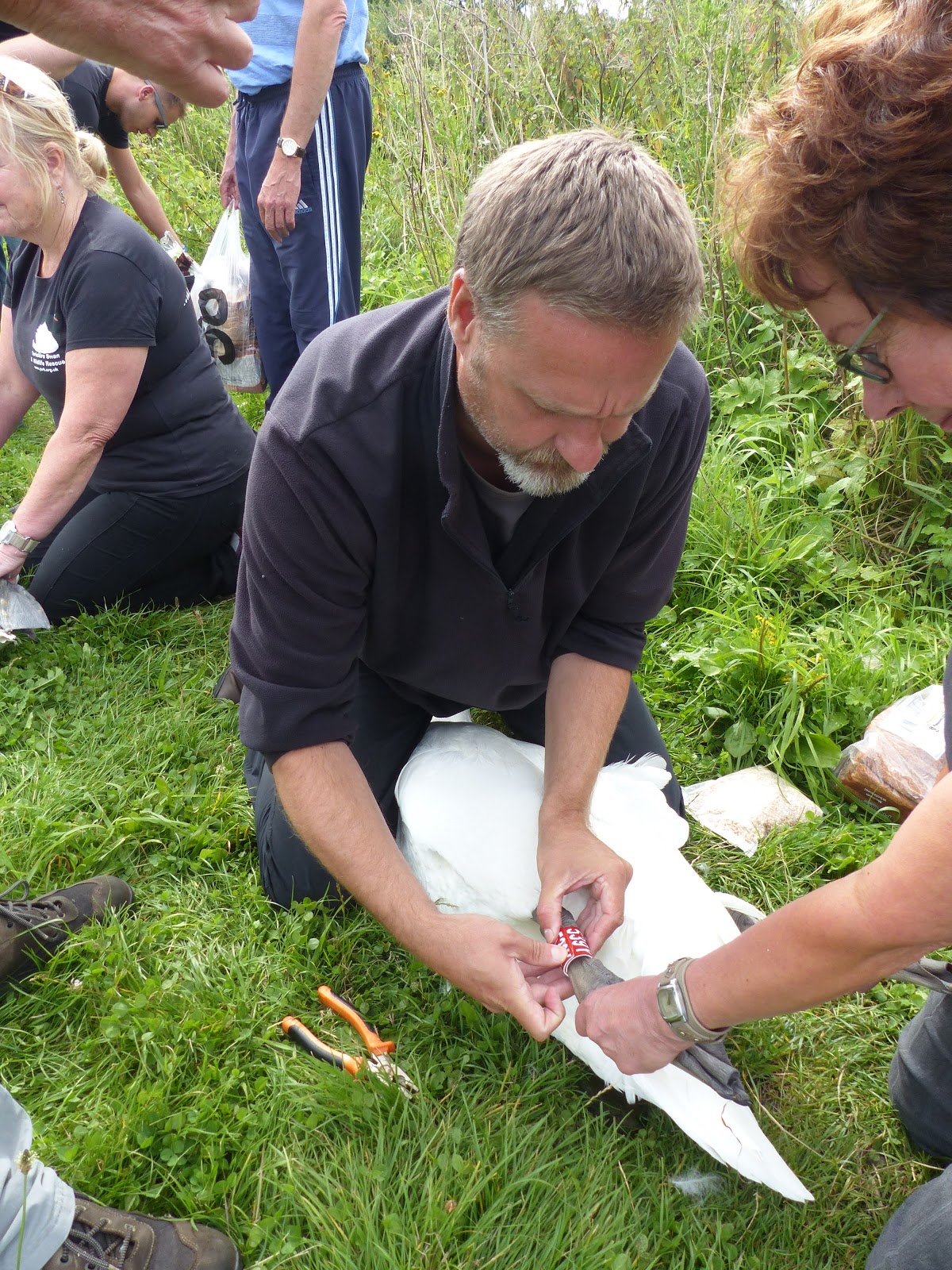
Darvic ring being fitted
Should you re-sight any bird wearing either a BTO ring or a coloured darvic ring please log your sighting with the BTO here.
Saturday, 12 August 2017
Ringing Success
After a couple of months break, we (Sorby Breck Ringing Group) were back down at Linacre this morning for a ringing session. As the title suggests, we had a very successful morning, with 72 birds of 10 species caught and ringed. All the birds, bar two, were juvenile birds.
The most numerous species caught was Blue Tit, comprising 42 birds (38 new and 4 retraps). All birds were born this year, and the retraps were birds that had been ringed this year in the boxes throughout Linacre, which is always good to see. We also caught 4 juvenile Great Tits (3 new birds and 1 retrap that had also been ringed in a Linacre box this year), 2 Coal Tits (1 adult and 1 juvenile), 2 Long-tailed Tits (both juveniles), 1 Wren (juvenile), 1 Song Thrush (juvenile) and 1 Goldfinch (juvenile).
To supplement the resident birds, we also caught 3 species of summer migrant; Blackcap (3 juveniles), Chiffchaff (6 juveniles) and Willow Warbler (9 juveniles and 1 adult). All in all, an excellent morning's ringing.

Other bird species seen during the morning included 12 House Martins, 1 Swallow and 2 Kestrels, which could have been an adult and a juvenile. A Painted Lady butterfly was also seen, the first site record since 2013 (see here), along with 1 Peacock, 1 Red Admiral and dozens of Cinnabar Moth caterpillars.
The most numerous species caught was Blue Tit, comprising 42 birds (38 new and 4 retraps). All birds were born this year, and the retraps were birds that had been ringed this year in the boxes throughout Linacre, which is always good to see. We also caught 4 juvenile Great Tits (3 new birds and 1 retrap that had also been ringed in a Linacre box this year), 2 Coal Tits (1 adult and 1 juvenile), 2 Long-tailed Tits (both juveniles), 1 Wren (juvenile), 1 Song Thrush (juvenile) and 1 Goldfinch (juvenile).
To supplement the resident birds, we also caught 3 species of summer migrant; Blackcap (3 juveniles), Chiffchaff (6 juveniles) and Willow Warbler (9 juveniles and 1 adult). All in all, an excellent morning's ringing.

Willow Warbler (juvenile)
Other bird species seen during the morning included 12 House Martins, 1 Swallow and 2 Kestrels, which could have been an adult and a juvenile. A Painted Lady butterfly was also seen, the first site record since 2013 (see here), along with 1 Peacock, 1 Red Admiral and dozens of Cinnabar Moth caterpillars.
Thursday, 10 August 2017
Linacre Insects
I've had a couple of sessions down at Linacre this week looking at the insect life.
Butterflies were well represented with Red Admiral (6+ in the ringing area), Peacock (8 in the ringing area), Meadow Brown (2), Gatekeeper (2), Speckled Wood (1), Comma (2), Common Blue (1) and Large and Green-veined White.


Butterflies were well represented with Red Admiral (6+ in the ringing area), Peacock (8 in the ringing area), Meadow Brown (2), Gatekeeper (2), Speckled Wood (1), Comma (2), Common Blue (1) and Large and Green-veined White.

Red Admiral
Hoverflies were also around with Volucella pellucens (a.k.a. Great Pied Hoverfly), Volucella inanis, Drone Flies (Eristalsis sp), Cheilosia illustrata , Leucozona glaucia, Marmalade Hoverfly and Myathropa florea (a.k.a. Batman Hoverfly due to the distinctive marking on the thorax).

Myathropa florea (male)
Dragon and Damselflies seen were: Common Blue Damselfly (dozens, including many pairs copulating), Blue-tailed Damselfly (2 males), Southern Hawker (1) and Brown Hawker (2).
Bees included: White-tailed, Red-tailed, Common Carder, Honey and Tree.
Cinnabar Moth caterpillars were seen as were 3 Yellow Shell moths.

Yellow Shell
Subscribe to:
Posts (Atom)