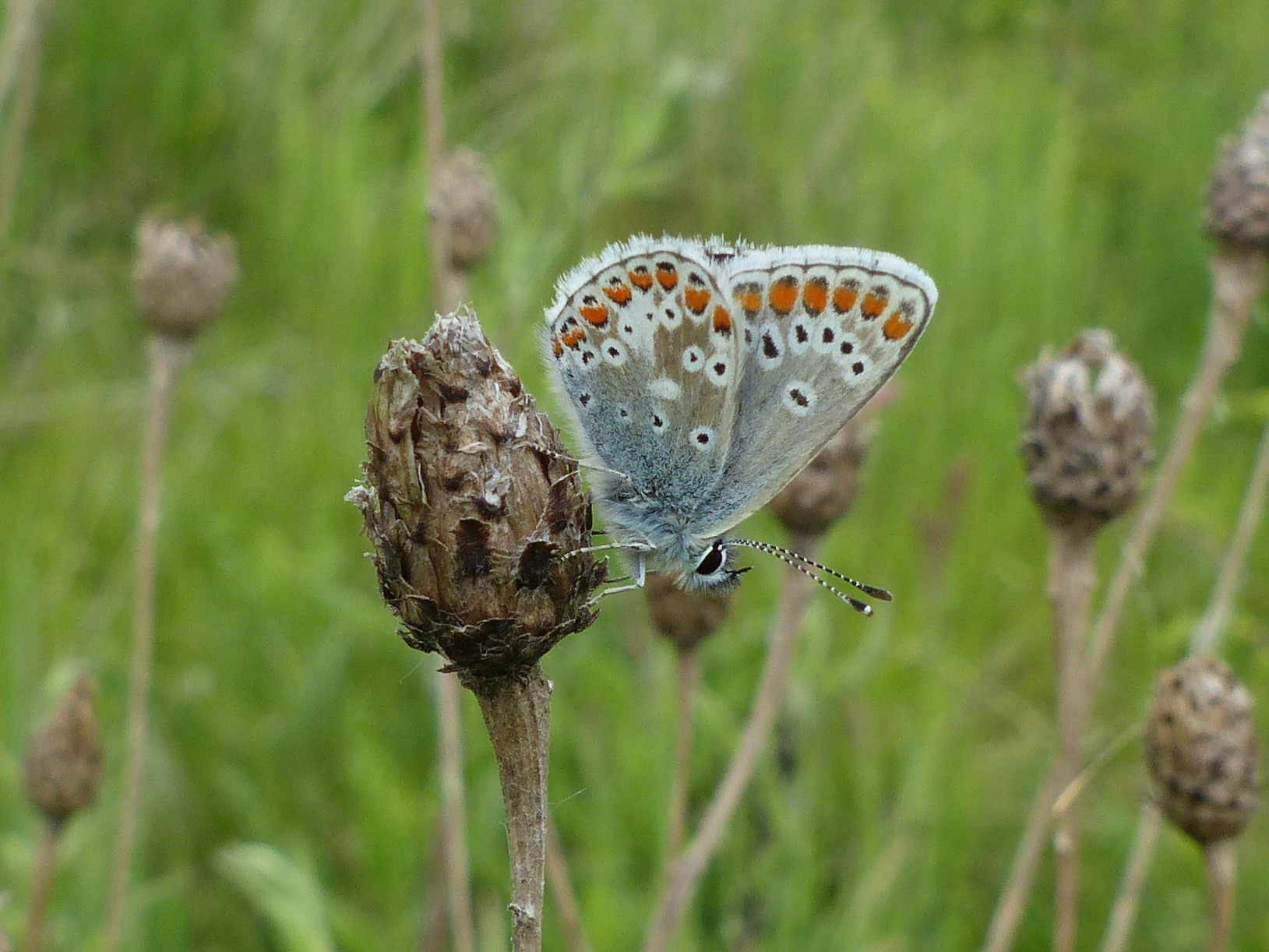
Showing posts with label Blue-tailed Damselfly. Show all posts

Saturday, 18 July 2026

Rufford - 18th July 2026

 I had a few hours free this afternoon, so I had my second visit of the "autumn" to Rufford CP. The number of Black-headed Gulls had increased to c.25, and I managed to see 3 ringed gulls.

The 3 birds seen were: 200H (2nd sighting this winter), 206A (1st sighting since 3rd January 2026) and 207C (1st sighting since 17th February). 

200H (losing the brown hood)

206A (full hood)

207C (fullish hood)

Other birds seen were: c45 Greylag Geese, c20 Canada Geese, Kingfisher (1 heard), 4 House Martins and 7 Mute Swans ( all un ringed, and looked like last year's birds).

It was quite overcast, so only managed to see 1 male Blue-tailed Damselfly (my first here) and 1 Red Admiral.

Tuesday, 14 July 2026

Red-veined Darter - at last!!!

 Earlier in the year, I blogged about a possible sighting of a Red-veined Darter, seen as RSPB Frampton Marsh. Unfortunately, at the time, the individual didn't stay in sight long enough to clinch the id. Likewise, I had a single dragonfly in Menorca a few years ago, but again, I couldn't be 100% clear on identification. 

After a significant influx into the UK this year, a very good number of Red-veined Darters were seen at a site, Waverley Lakes/Lagoons, in South Yorkshire, just half an hour from home. I popped across last week, but didn't manage to find any. Another report came in yesterday of 30+ individuals (including pairs in tandem and ovipositing), so, this afternoon, I drove across again, and, after 20 minutes I eventually managed to find, and photograph my first confirmed sighting!


Red-veined Darter (male)

These photos were the best I could do, as they are extremely flighty and hard to pin down. Luckily, though, I managed to see to get a shot of the red veins, and the yellow pterostigma, complete with an obvious black border. The blue lower half of eye can also just be seen. I'll pop back again this summer, and hopefully get a few better shots.

Other species seen were: Small Red-eyed Damselflies (ovipositing), Blue-tailed Damselflies (in tandem) and Black-tailed Skimmer (10+ individuals, including this pair "in cop").

Black-tailed Skimmer

Friday, 26 June 2026

Fledgling Blackcap

 It isn't often that I do a post for one species, but last night, whilst out  looking for a Lesser Emperor dragonfly at Pebley Pond (no luck!!), Jayne and I came upon this fledgling Blackcap.

Blackcap

I say we found it, rather it found us! It appeared out of the bushes, as we were walking along, and perched 1m away, looking rather confused. We were, obviously, the first humans it had ever seen, and it just didn't know what to. It was only the calling adult, that eventually had it hopping back into the undergrowth. Good luck little one.

Whilst there, we also saw a single Emperor dragonfly, 1 Blue-tailed Damselfly, 10s of Common Blue Damselflies, c4 Ringlet butterflies, 10 Meadow Browns and c4 Large Skippers.

Sunday, 21 June 2026

Linacre Lifer!

 I didn't really think that this weekend could get any better, after yesterday's lifer. But, this afternoon, after having spent time celebrating Father's Day, I went down to Linacre for just over an hour (3pm - 4.15pm) and discovered a new species of dragonfly for the site!

The dragonfly in question was a male Black-tailed Skimmer. It isn't an uncommon species, being widespread across Derbyshire, but, as I mentioned, this was my first record for the site. The individual was a "mature" male, as seen by the yellow markings down its thorax, and was found, basking in the 24 degree heat, on the stones of the bottom reservoir. Now I just need to find a female and prove breeding!!

Black-tailed Skimmer

Other insects seen were: Common Blue Damselfly (20+, including pairs in tandem), Blue-tailed Damselfly (1 male), 1 Comma, 1 Red Admiral, Meadow Browns (10+), Ringlets (2), 1 Great Pied Hoverfly, a Eupeodus sp Hoverfly (identified as E. corrallae by ObsIdentify), 1 Silver Y moth and several species of bumblebee (Red-tailed, Common Carder and White/Buff-tailed).

I only checked the birds on the bottom reservoir, and recorded: Mallard (1 female with 7 new ducklings, plus several moulting adults), Mandarin Duck (3 birds, all moulting), Moorhen (2 adults), Tufted Duck (9 males and 1 female - no ducklings), Great-crested Grebe (2 adults) and 1 Stock Dove (drinking from the reservoir). A single Garden Warbler was heard singing (and identified via Merlin app) in the ringing site.

Sunday, 31 May 2026

RSPB Frampton Marsh - 31st May 2026

 Today, Jayne and I had a trip across to RSPB Frampton Marsh. We had a great walk around the reserve, adding three new species to the Year List, and were also, very pleased to see a lot of young birds running around the reserve and adults with beaks full of insects.

Firstly, the year ticks: Little Gull (167), a first summer bird seen flying over the Reedbed Lagoon, Corn Bunting (168; 1, possibly two singing birds) and Black-winged Stilt (169) - 1 of 2 birds present.

Black-winged Stilt

Other birds seen were: Green Woodpecker (1 seen by the carpark, Spoonbill (3), Cuckoo (1 heard), Mute Swan (a pair with 7 cygnets and another 12 non-breeding birds), Greylag, Egyptian and Canada Geese,  Mallard, Gadwall (adults and 1 brood of ducklings), Shoveler (adults and ducklings), Shelduck, Redshank, Avocet, Lapwing (all with young), Black-headed Gulls (chicks), Great-crested Grebe, Coot, MoorhenReed, Cetti's and Sedge Warblers, Linnet, Blue and Great Tits, Reed Bunting (carrying food) and  Yellow Wagtail (1 adult and 1 juvenile on the reserve, and 1 adult on the road in).

Reed Bunting

Lapwing

Gadwall and ducklings

Avocet and chick (1 of 3)

Insects seen were: Painted Lady (20+), Common Blue Butterfly, Large Skipper, Common Blue Damselfly, Blue-tailed Damselfly and Migrant Hawker (2). 2 Red-veined Darters had been reported on site yesterday. We saw a single red darter, but, annoyingly, we weren't able to see it face on, or get a photograph, before it flew off!!! The one that got away?

Painted Lady

Wednesday, 27 May 2026

Pleasley Pits - Butterflies and Dragonflies

Yesterday, in the 32 degree heat (!), I decided to have a drive over to Pleasley Pit to try and see my first dragonflies of the year and a few butterflies. 

The first species I saw was Small Blue. There weren't that many flying, but I did manage to see a few individuals and a mating pair. Other butterflies seen were: Common Blue (2 males), Brimstone (1 male) and a single Comma. One Burnet Companion and one Silver-ground Carpet (day-flying moths) was also seen.


Small Blue

Damselflies seen were: Common Blue, Blue-tailed, Large Red and Azure.  Two species of dragonfly: Four-spotted and Broad-bodied Chaser were also seen.

Four-spotted Chaser

Broad-bodied Chaser

Monday, 12 May 2025

Pleasley Dragons and Butterflies

 Yesterday, the temperatures hit 23 degrees, with lots of sun and blue skies, so Jayne and I drove across to Pleasley Pit to see if there were any dragon and damselflies about. In total, we saw 5 species and 6 species of butterfly.

The first damselflies we saw were Large Red Damselflies. In total, we saw a minimum of 15 pairs "in tandem" and ovipositing. Next up, were Azure and Blue-tailed Damselflies, with just 1 of each seen. 

Two species of dragonfly were seen: Broad-bodied Chaser (1 male seen) and Four-spotted Chaser (2 seen).

Four-spotted Chaser

After the dragonflies, we had a quick check on the Small Blues. 10+ were seen, along with 1 Common Blue,  1 Holly Blue, 1 Orange Tip, 1 Brimstone, Large White and a single Burnet Companion (day-flying moth). 

Saturday, 11 May 2024

First Dragons and Butterflies

 Last week, Jayne and I went to RSPB Old Moor (see last post). Whilst there we had our first damselflies of 2024. The two species seen were: Large Red and Blue-tailed Damselfly.

Today I went to Pleasley Pit to look at the colony of introduced Small Blue butterflies. There were 6 flying around, and landing on my feet!

Small Blue

My foot (and a Small Blue)

Small Blue

Whilst there, I also saw Large Red (c.5) and Blue-tailed Damselfly (1 male), but, by far the biggest surprise, was a female Hairy Dragonfly ovipositing!! I put the record on IRecord, and it appears that it's only the second record of the year for Derbyshire! In addition, it's my first record for this site.


Hairy Dragonfly

Saturday, 15 July 2023

The Gulls are Back!!

 Late this morning, I had a drive across to Rufford for the first visit since March, looking for the returning Black-headed Gulls.

I was in luck, with 20 birds (all adults) seen on the main lake, including the first darvic-ringed bird of the autumn, 293A! This bird was ringed at Center Parcs, as an adult, in December 2021, and was last seen in February 2022. No breeding season sightings have been reported, yet.

293A

Whilst there, Jayne and I had a walk around and spotted some good insects as well: Common Dater (1, my first of the year), Blue-tailed Damselfly, Emerald Damselfly (1, also my first of the year), a Hawker sp, Comma (4), Small White (10+), Red Admiral (1), Peacock (1) and Gatekeeper (1 being eaten by a female Blackcap!). We also had Swallows and House Martins over the lake.

Common Dater

Saturday, 8 July 2023

Linacre 8th July 2023 - a new species!!

I had news yesterday that the first Silver-washed Fritillaries and White-letter Hairstreaks of the year had been reported at Linacre (thanks  Pete). I set out this morning (6.15am - 9.15am) to see if I could spot either species. Unfortunately, the weather wasn't quite as good today (20 degrees, instead of 26 degrees yesterday), and the cloud cover was much higher, so I "dipped" on both species.

Luckily for me, however, I did manage to spot a new species of butterfly for Linacre - a female Dark Green Fritillary!! This species does seem to be on the increase in Derbyshire, and today's individual was spotted feeding on thistles in the hay meadow by the top reservoir.

Dark Green Fritillary

Whilst there, I also spent some time in the field just beyond the top reservoir, where I spotted: Meadow Brown (c.10), Ringlet (c.5), Red Admiral (1), Large White (1), Small Skipper (3), Large Skipper (1), 2 Volucella pellucens (hoverfly) and a couple of 7-spot Ladybirds

Small Skipper

Large Skipper (patterned wings and hooked antennae)

Back on the top reservoir, the sun had come out again, and the number of damselflies had increased. Only two species were seen: Common Blue and Blue-tailed (first Linacre record of 2023), but both species were seen "in tandem", proving breeding. A Common Lizard was also seen by the top reservoir, but it was disturbed by 3 joggers (!!) before I could get a photo.

Blue-tailed Damselflies

Common Blue Damselfly

Hoverfly numbers were better today, with Volucella pellucens (2), a Sphaerophoria sp, Marmalade Hoverflies, and a Syrphus sp seen.

Last, and by no means least (!), were the birds. Waterbirds were: Mallard (147), Moorhen (19), Coot (24), Mandarin Duck (43), Tufted Duck (26), Grey Heron (1), Cormorant (1), Great-crested Grebe (13; 6 adults and 7 juveniles), Grey Wagtail (2; 1 adult and 1 juvenile), Lesser Black-backed Gull (1), Black-headed Gull (1 heard - an unusual July record), Little Grebe (1 adult heard), Buzzard (1), Chiffchaff (4 singing), Blackcap (3 birds seen and 3 heard),  Swallow (3), House Martin (3) and Swift (1 - my first Linacre record of 2023!!!).

Sunday, 22 May 2022

21st May 2022 - First Dragons and Damsels

 Jayne and I had a walk around Seymour Ponds yesterday, and saw our first Damsel and Dragonflies of the year.

The first species seen was Blue-tailed Damselfly, followed closely by Large Red and Azure Damselflies. Several Four-spotted Chasers were also seen flying around.

Four-spotted Chaser

In addition to the damselflies, we also saw a few butterfly species: Orange Tip, Brimstone, Green-veined White, Small Heath and one of my favourites, Brown Argus.

Brown Argus (underwing)

Brown Argus (upperwing)

Thursday, 15 July 2021

Shaded Broad-bar and Tawny Owl

 I popped down to Linacre this afternoon to fill the feeders for a ringing session. It was 24 degrees when I arrived at 3.45pm and very sunny. As I walked down to the feeders, I spotted my first Cinnabar moth caterpillars, along with two Shaded Broad-bar moths, Soldier beetles, Swollen-thighed beetles, a male Blue-tailed Damselfly, several Common Blue Damselflies and a single Black and Yellow Longhorn Beetle.

Shaded Broad-bar

When I got to the feeding station I  spotted something perched low on one of the trees. I couldn't quite tell what it was, as it was preening and had its face down. Luckily, it hadn't seen me, so, as it looked up, I managed to get this photo and saw that it was a juvenile Tawny Owl - lovely and a great breeding record!

Tawny Owl

Saturday, 10 July 2021

Yorkshire Sculpture Park - 10th July 2021

 Jayne and I were at Yorkshire Sculpture Park today. After a misty start, the sun came out and we ended up with a few insect species. By far the most numerous butterfly seen was the Ringlet butterfly, with 20+ present, including one breeding pair. The other butterfly species species seen were Large Skipper and  Meadow BrownCommon Blue and Blue-tailed Damselflies were also seen as was a male Black-tailed Skimmer.

Common Blue Damselflies

Large Skipper

Black-tailed Skipper

As well as the insects, we also saw a Little Egret, a Kingfisher and a darvic-ringed Mute Swan (Y736). The swan was paired and appeared to have at least 4 cygnets. Unfortunately, I wasn't able to see see the legs of the other swan to see if it was ringed. I know that the bird was ringed by Sorby Breck ringing Group, and I'll update when I get details of where and when it was ringed.

Mute Swan Y736

Wednesday, 12 August 2020

Linacre - 12th August 2020

 The temperature was a cracking 27 degrees again today, so I decided to have a couple of hours down at Linacre to see which insects I could see. I started off in the ringing site and saw 4 Gatekeepers, 1 Comma, 2 Peacock, 2 Small Coppers, 1 Red Admiral, 2 Silver Y moths, and 3 Shaded Broad Bars

Silver Y

Small Copper

Walking around the reservoirs, I added Common Blue Damselflies (including pairs ovipositing), 4 Brown Hawkers (my first Linacre record of 2020), a couple of male Blue-tailed Damselflies, and, very nicely, a male Banded Demoiselle flying over the top reservoir (my first Linacre record since 2015, and only my second ever record here). Another hawker, possibly Southern, was seen hunting along one of the paths by the middle reservoir. 

There were plenty of hoverflies around the site, including 1 Volucella pellucens a.k.a. Great Pied Hoverfly, and a single Myathropa florea a.k.a. "Batman hoverfly".

Myathropa florea

Birdwise, it was quite quiet, as is to expected, but I did have 2 Black-headed Gulls on the bottom reservoir (a very unusual August record), 11 Great-crested Grebes (2 family parties with 4 and 3 chicks, and 4 adults) and 2 Kingfishers on the bottom reservoir.

Wednesday, 22 July 2020

Linacre - 22nd July 2020

I had a couple of hours at Linacre this afternoon. When I arrived at 12.30pm it was grey, overcast and just 17 degrees. I started down at the bottom reservoir where I was very lucky to see a Kingfisher fly up from the river, over the wall and along the water. Also on the water were 20+ Mallards and a breeding plumaged Black-headed Gull. This gull was a very unexpected sighting, as the first ones don't usually return until September or October! One adult Lesser Black-backed Gull was also present on the top reservoir.

Black-headed Gull

About half way round, the sun came out, and so did the insects! 8 species of butterfly were seen: Large White (1), Small White (2), Green-veined White (1), Ringlet (2), Meadow Brown (c.10), Gatekeeper (2), Comma (2) and Peacock (1). A new species of day-flying moth, 6-spot Burnet Moth (3), was also seen, as were 2 species of damselfly: Common Blue Damselfly (c.3 pairs in cop and ovipositing) and Blue-tailed Damselfly (1 male and 1 female of the "rufescens" form).

Common Blue Damselflies in cop

Blue-tailed Damselfly (female)

Other insects seen included my first Volucella pellucens (Great Pied Hoverfly) of the year (2), 2 Black and Yellow Longhorn Beetles and several species of bumblebee and droneflies.

Great Pied Hoverfly

Black and Yellow Longhorn Beetle

Saturday, 30 May 2020

Linacre Insects - 30th May 2020

I was down at Linacre this morning, checking the nestboxes and ringing some of this year's pulli (more on that in a future blog). With the temperature being around 19 degrees whilst there, I also managed to get some good insect records, including a new species for me at Linacre.

Insects seen today were: Large Red Damselfly (1 male), Common Blue Damselfly (c5 males), Blue -tailed Damselfly (1 male, the first Linacre record of 2020), Broad-bodied Chaser (1 female, my first Linacre record since 2014!), Swollen-thighed Beetle, Red and Black Froghopper, Cinnabar Moth (1), Silver Y moth (1), Silver-ground Moth (1), a long-horned moth, Nemophora degeerella, bees including Tree, Red-tailed and Common Carder,  and a couple of yet-to-be identified micro moths.

Broad-bodied Chaser

The new species was Britain's largest species of Crane fly, Tipula maxima. It was very big indeed! Apparently, it can have a leg span of up to 100mm.

Tipula maxima