On Monday, Jayne and I stopped off at the National Trust's Bodnant Gardens, on route to Anglesey.
We had a walk around the site, and noted a few nice butterflies, including two new for the year: Clouded Yellow and Common Blue Butterfly.
On Monday, Jayne and I stopped off at the National Trust's Bodnant Gardens, on route to Anglesey.
We had a walk around the site, and noted a few nice butterflies, including two new for the year: Clouded Yellow and Common Blue Butterfly.
Jayne and I had a walk around YSP today, and added a new species for the year, saw 3 ringed Mute Swans and managed a beautiful picture of a Brown Hawker.
The "year tick" was a single Spotted Flycatcher (173). This is a new species for us at this site. Unfortunately, no photo, as it flew away as soon as we spotted it!
The three ringed swans were 31Y3, 9Y63 and 6Y97. They all appeared to see last year's youngsters (aged 5), and will all have been ringed by Yorkshire Swan and Wildlife Hospital.
It isn't often that I do a post for one species, but last night, whilst out looking for a Lesser Emperor dragonfly at Pebley Pond (no luck!!), Jayne and I came upon this fledgling Blackcap.
On Thursday, Jayne and I went out to Calke Abbey for a visit. Afterwards, we followed up on a tip, and visited Newton Solney to see two "year ticks", and 2 new species of odanata.
The new bird species were: Cattle Egret (165) and Egyptian Goose (166). 3 breeding plumaged Cattle Egrets were seen, along with 7 Egyptian Geese. Unfortunately, neither species wanted to have their photo taken! Other species of note were, 1 Little Egret and a female Goosander, with 3 well grown young.
As we got out of the car a teneral Emperor dragonfly was seen, perched in the hedgerow. Unfortunately, it too was camera shy i.e. I was too slow!!! Thankfully, the nearby Banded Demoiselles (40+) were a little more willing.
After our morning visit to Calderon Hondo, Jayne and I drove across the island to the beautiful village of Betancuria, where we spent a few hours discovering the old own and church, whilst also adding two new bird species to the list.
The first new bird species seen was a single, male Atlantic Canary (8th lifer), that was singing in a tree above the car park. Unfortunately, this was our only sighting, and he flew off before I could take a photograph! The second new species was African Blue Tit (9th lifer). One adult and 2 juveniles were seen, around the car park. Again, I only managed very fleeting views, and these were the best shots I got.
Today, Jayne and I visited RSPB Pagham Harbour and Kithurst Hill. The first site was a new reserve for us, where we set out to find some terns. The second site, also a new place to visit, was visited in search of butterflies.
We arrived at Pagham and found out that the tern colony had been badly hit by Bird Flu for the last few years. As a result, there weren't any birds nesting this year! The ranger did say, however, that there still a few birds flying around, so we set off on the on the 1.6 mile walk down to the beach. On the way, we spotted many small birds, including Cettis Warbler, Linnet, and Whitethroats. The tide was out, but we still managed to see a few water birds: Shelduck, Dunlin (c.30), Bar-tailed Godwit (6), Redshank, Mediterranean Gull (2 adults flying over), Black-headed Gull, Little Egret, Sandwich Tern (1 flew over - 174), Whimbrel (2 birds - 175) and Little Tern 3 birds - 176).
Back at the centre, we had a look around the Discovery Area, where a juvenile Tawny Owl was sitting in a tree near the nestbox. We also saw several Broad-bodied Chasers (males and females ovipositing), Common Blue Damselflies (in tandem) and a single male Emperor dragonfly.
After Pagham, we drove across to Kithurst Hill, in search of Duke of Burgundy butterflies. Unfortunately, we seemed to be a little late in the year, but we did spot: Dingy and Grizzled Skipper, Common Blue Butterfly, Small Blue, Cinnabar Moth, Vapourer moth caterpillar, Common Carpet and Common Lizard.
After our walk in Holt Country Park, we drove across to Mannington Gardens. We had a walk around the grounds and spotted some nice wildlife.
First up were the butterflies: Comma, Peacock, Red Admiral, Gatekeeper, Large White, Green-veined White, Meadow Brown and 1 Silver-washed Fritillary.
Dragonflies seen were: Emperor ( 1 male and 1 female ovipositing in the moat), Black-tailed Skimmer (1 male), Common Darter and Small Red-eyed Damselfly (2 males seen).
Other insects seen were: Roesel's Bush-cricket (my second in one day!!) and another new species, a Red-legged Shieldbug (Pentatoma rufipes).
The weather forecast for this morning was dry and sunny (!!!), so I spent 5 hours (8.30am - 1.30pm) on site to see what I could see. As the title of today's blog shows, it was a very well spent few hours. The total of 18 species must be my best ever, and included four brilliant species: White-letter Hairstreak, Purple Hairstreak, Silver-washed Fritillary and Dark Green Fritillary. In addition, I recorded 2 new species for the site, an Emperor dragonfly and a Hummingbird Hawkmoth!
3 species of day-flying moth were also seen: Shaded Broad Bar (2), 6-spot Burnet Moth (1) and Hummingbird Hawkmoth (1 in the ringing site - a site first).
4 species of Dragon/Damselfly were present: Brown Hawker (1, including 1 ovipositing in the bottom reservoir), Emperor Dragonfly ( 1 on the middle reservoir, a first site record for me), Common Blue and Blue-tailed Damselflies.
Hoverflies seen were: Marmalade, Volucella pellucens , Myathropa florae and Eristalis sp.
Two species of ladybird were seen: 7-spot and Harlequin.
I think there might have been some birds around too (!), but I didn't do a full count. Instead here are a few of the "best": Swallow (6), House Martin (2), Canada Goose (2 on the top reservoir), Buzzard (2 adults), Stock Dove (1 by the muck heap by the main entrance), Lesser Black-backed Gull (1 adult), Willow Warbler (1 very yellow juvenile bird by the top reservoir) and Chiffchaff (1 singing and lots of "wheeting").
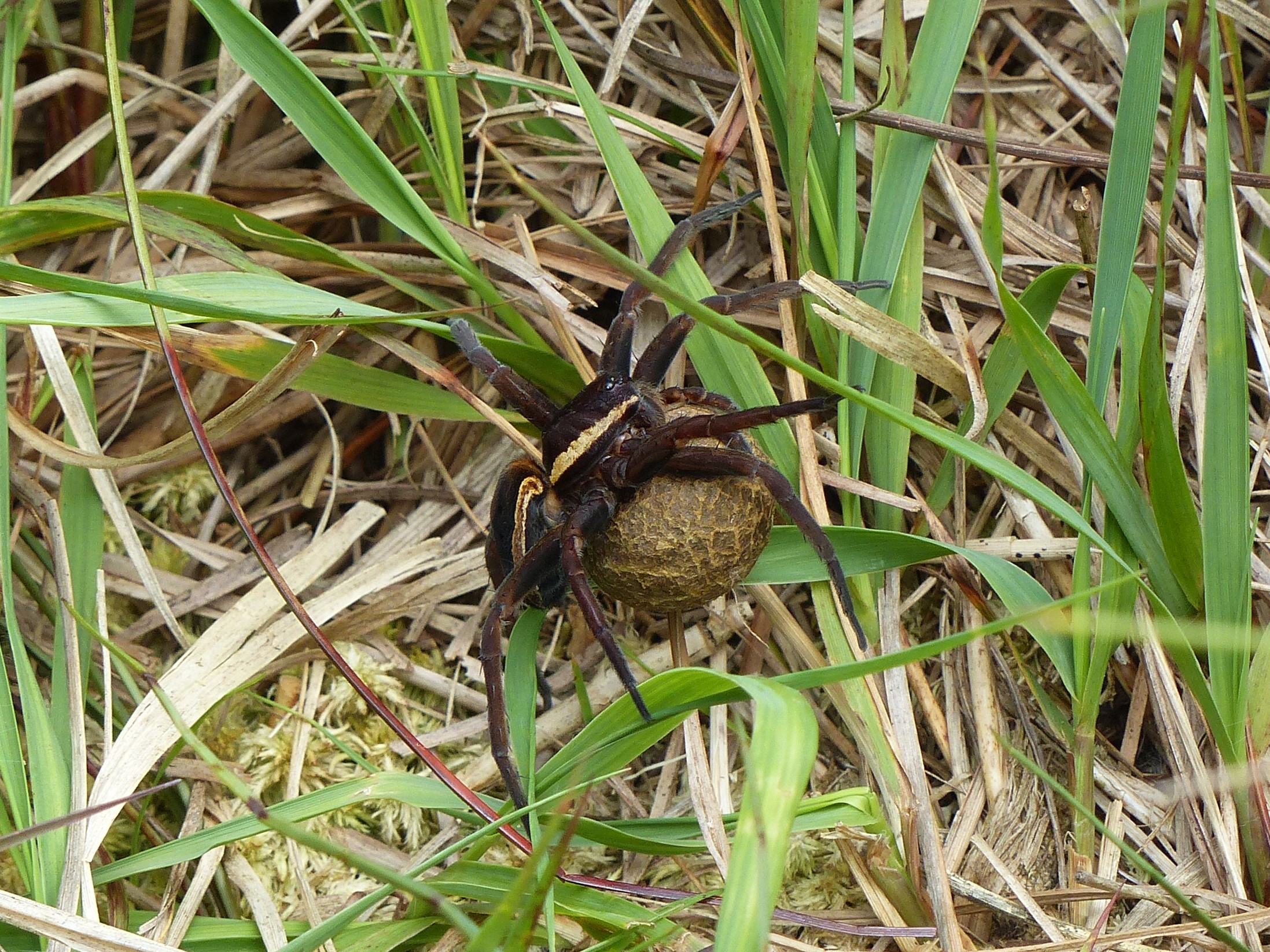
Today I made a return trip to Whixall Moss to try and catch up with the two species I missed on my last visit, at the start of the month: Large Heath and Raft Spider (Dolomedes fimbriatus). This time, I joined a guided walk, with a couple of experts - good move!!!
Within a few minutes of being back on the moss we had spotted a Raft Spider on the water. This first sider was a male, and just 10ft away was a female carrying an egg sac. Fantastic!!
Our guide also pointed out some of the special plants that can be seen on site, including Bog Asphodel, Lesser Bladderwort, Cranberry, Sundew and Royal Fen.
Jayne and I had a walk around the ponds at Hardwick Hall yesterday. It was 20 degrees, with a lot of cloud cover and a few sunny spells.
Whilst there we saw 6 species of odanata, the highlight being my first record of Small Red-eyed Damselfly for this site. Other species seen were: Red-eyed Damselfly, Common Blue Damselfly, Emperor, Brown Hawker and Black-tailed Skimmer.
I spent a couple of hours at Pleasley Pit Nature Reserve yesterday afternoon, after seeing reports on social media, of both Small Red-eyed Damselfly and Brown Hairstreak (butterfly) there.
When I arrived I went straight to the "dragonfly ponds", where I met (by accident) the person who had posted details of both species the day before. He gave me directions of where to find the damselfly, and I managed to get excellent views (about 2m away) of at least 4 males. This is only my fourth siting of this species (see here), and my first in Derbyshire. I managed to get lots of photos, but this one is my favourite as it shows the diagnostic features, separating it from the much commoner Red-eyed Damselfly.