Showing posts with label Common Darter. Show all posts

Sunday, 24 August 2025

RSPB Frampton Marsh - 22nd August 2025

 Every year, at about this time, Jayne and I drive over to RSPB Frampton Marsh to catch up with a few passage waders, that can be seen, at this time of the year. It also gives us a chance to catch up with a damselfly that I haven't yet manged to find in Derbyshire.

This year has been very dry all across the UK, so most of the usual pools at Frampton were dried out. This meant that the birds that were there, were concentrated onto the few, remaining wet areas. We visited one, by the side of the reedbed, where we spotted a very obliging Wood Sandpiper (193) and 2 less obliging Green Sandpiper (194), that flew straight off!! 

Wood Sandpiper

After lunch, we went across to the Reedbed Hide were we spotted c.100 Greylag Geese,  Black-tailed Godwits (c.30), Lapwing, 3 juvenile Shelduck, Ruff (6), Avocet (1), juvenile Little Ringed Plovers and 4 Little Stint (195).

Little Stint

Our final stop was the dragonfly/dipping pool, where we spotted a couple of mating Migrant Hawkers and a pair of Willow Emerald Damselflies (in tandem). Common and Ruddy Darters were also seen, as was a pair of Common Blue Butterflies and a single Small Copper.

Migrant Hawkers

Willow Emerald Damselflies

Saturday, 31 August 2024

Linacre - 31st August 2024

 Based on the year so far, this afternoon's walk around Linacre, was by far the best one for insects this summer. In total, I saw 7 different species of butterfly, along with 3 dragonfly species, 4 hoverfly species and a few other insects. In addition, I go my first Linacre Hobby since 2013!!

The butterflies seen were: Peacock (9), Red Admiral (5), Speckled Wood (5), Large White (1), Small White (4), Comma (2) and Meadow Brown (2).

The dragonfly species were: Migrant Hawker (2), Brown Hawker (2) and Common Darter (1).

Migrant Hawker
 
The hoverfly species were: Eristalis sp, Helophilus pendulus (1), Volucella pellucens a.k.a Great Pied Hoverfly and (1)Volucella inanis (1). Other insects seen included a Scorpion Fly, a 7-spot Ladybird and a Large Yellow Underwing

Volucella inanis

Birdwise, it was quite quiet, but the obvious highlight was a Hobby that was chasing a couple of Swallows! My last Linacre record of this species was way back in September 2013!! Other birds seen were: Canada Goose (20 on the top reservoir), Great-crested Grebe (4; 2 adults and 2 juveniles), Little Grebe (1), Swallow ( 4 in total), wheeting Chiffchaffs, Grey Heron (1), Tufted Duck,  Mallard and Mandarin Duck.

Sunday, 15 October 2023

Lesser Yellowlegs!!!!

 This weekend, Jayne and I went across to RSPB Frampton Marsh to try and see a couple of North American waders, that have been present for a couple of weeks. We dipped one (Semipalmated Sandpiper), but we did manage to get fantastic views of the other species, Lesser Yellowlegs (189 and lifer number 4 of the year) as it fed about 10m away, in front of East Hide. What a fantastic bird to catch up with!


Lesser Yellowlegs

Other birds seen were: Little Stint (190th bird of the year), Curlew Sandpiper, Whooper Swan (1), Peregrine Falcon, Kestrel, Marsh Harrier, Teal, Wigeon, Mallard, Pintail (1fm), Lapwing, Dunlin, Canada, Dark-bellied Brent and Greylag Goose, Mute Swan, Goldfinch and Greenfinch.

There were a few insects flying about, including 1 Red Admiral, 2 Migrant Hawkers, 3 Common Darters, and a very small damselfly, most likely a Willow Emerald Damselfly

Saturday, 15 July 2023

The Gulls are Back!!

 Late this morning, I had a drive across to Rufford for the first visit since March, looking for the returning Black-headed Gulls.

I was in luck, with 20 birds (all adults) seen on the main lake, including the first darvic-ringed bird of the autumn, 293A! This bird was ringed at Center Parcs, as an adult, in December 2021, and was last seen in February 2022. No breeding season sightings have been reported, yet.

293A

Whilst there, Jayne and I had a walk around and spotted some good insects as well: Common Dater (1, my first of the year), Blue-tailed Damselfly, Emerald Damselfly (1, also my first of the year), a Hawker sp, Comma (4), Small White (10+), Red Admiral (1), Peacock (1) and Gatekeeper (1 being eaten by a female Blackcap!). We also had Swallows and House Martins over the lake.

Common Dater

Sunday, 16 October 2022

Clumber Mute Swans - 16th October 2022

Jayne and I had a lovely walk around the main lake at Clumber Park this afternoon. Gull numbers were beginning to build up (200+ Black-headed Gulls were seen, but, unfortunately, no rings as the gulls stayed in the water) and we also saw 100+ Mute Swans, including 9 cygnets.

The majority of the swans also stayed in the water, but we did spot two darvic-ringed birds, Y204 (a 3-year-old bird with metal ring W48404) and Y677 (a 2-year-old bird with metal ring W51077). Both birds had been seen by us there before (click on the labels to see their life histories). The best sighting of the day (or rather hearing??) was two Cetti's Warblers that we had, our first record for this site. Two Little Egrets were also seen.

Y204

Y677

It was sunny and quite warm today, around 13 degrees, so there were plenty of Common Darters flying about (10+), including several pairs egg-laying. a couple of Migrant Hawkers were also seen, as were three Hornets.

Wednesday, 19 August 2020

Small Red-eyed Damselfly

 I spent a couple of hours at Pleasley Pit Nature Reserve yesterday afternoon, after seeing reports on social media, of both Small Red-eyed Damselfly and Brown Hairstreak (butterfly) there.

When I arrived I went straight to the "dragonfly ponds", where I met (by accident) the person who had posted details of both species the day before. He gave me directions of where to find the damselfly, and I managed to get excellent views (about 2m away) of at least 4 males. This is only my fourth siting of this species (see here), and my first in Derbyshire. I managed to get lots of photos, but this one is my favourite as it shows the diagnostic features, separating it from the much commoner Red-eyed Damselfly.

Small Red-eyed Damselfly

The key identification features include a smaller size, the blue sections on top of segments nine and ten (last two segments at the end), and on the sides of segments eight (third from the end), one and two, of the abdomen, paler red eyes and a black "X"-shaped marking on the top of segment ten. One other feature, shown nicely in this photo, is the way the abdomen is held slightly up turned (Red-eyed Damselflies hold it straight when at rest).

Whilst on site, I also managed to spot several other species, including Emperor (female ovipositing), Migrant and Southern Hawker, Emerald Damselfly, Common and Ruddy Dater.

Ruddy Darter (obelisquing to keep cool)

The other reason for my visit was to hopefully see Brown Hairstreak butterflies. Despite a couple of "possibles" I didn't confirm a siting (this time!) as the rain started. I did, however, see 3 Small Tortoiseshell, 1 Brimstone and 1 Meadow Brown.

Tuesday, 21 July 2020

Baslow Edge- 19th July 2020

Jayne and I had a walk from Curbar Gap up to Baslow Edge on Sunday. Bird wise, it was pretty quiet, with just the usual Meadow Pipits and a few Crows flying around, but we did enjoy some butterflies, moths and dragonflies.

We started out walk on Clodhall Lane and walked across to the small pond. Here we had a very brief view of a hawker dragonfly, possibly Common. Unfortunately, we weren't able to see it again, so couldn't clinch the id. We did, however, see a couple of Emerald Damselflies and a couple of Common Darter. Walking on from there, towards the Wellington Monument, we sat by a small stream to watch a fantastic male Golden-ringed Dragonfly that was patrolling a small stretch of water by the path. He also perched up on the rocks allowing us some superb views and  a photo.

Golden-ringed Dragonfly


The butterflies seen were Ringlet (10+), Small Tortoiseshell (3), Small Heath (5+), Red Admiral (1), Gatekeeper (1), Small Skipper (3), Large Skipper (1), Meadow Brown (5) and best of all, a Painted Lady (our first record for 2020). 

Painted Lady

We also saw 2 species of day-flying moth, 3 Narrow-bordered 5-spot Burnet Moths and a Yellow Shell.

Narrow-bordered 5-spot Burnet Moth 

Saturday, 31 August 2019

Linacre Insects

I spent a few hours at Linacre over the last few days and recorded the following insects: Southern Hawker (1), Brown Hawker (3, including 1 ovipositing female), Common Blue Damselfly (2 males) and Common Darter (2 tenerals on 30th - my first 2019 record).

Brown Hawker (female)

Common Darter

Butterflies seen were: Red Admiral (3), Painted Lady (1), Large White (1), Green-veined White (1), Common Blue Butterfly (2 males and 1 female), Wall Brown (1), Small Tortoiseshell (1), Peacock (2), Speckled Wood and Small Copper (3).

Small Copper

Monday, 26 August 2019

Herring Gull EPM

Jayne and I were in Llandudno over the weekend. Whilst there we spotted a Herring Gull with a colour ring, EPM. I recognised it straight away as a bird I'd seen there before, in December 2016 (see here for details and ringing and subsequent re sightings).

EPM
I sent the record off, and saw that it had now been reported on the sea front at Llandudno another 6 times since my sighting. All sightings range from September to April, with mine being the earliest "winter" record, so we still don't know if it breeds elsewhere, and winters in Llandudno. It is now  9 years and 255 days since it was ringed.

Whilst in North Wales, we visited the National Trust's Bodnant Gardens again, and saw Azure and Blue-tailed Damselflies, Common Darter (mating pairs) and several Southern Hawkers. Butterflies seen were: Painted Lady (10), Red Admiral, Peacock, Speckled Wood, Small Tortoiseshell and Common Blue.


Common Darter

Azure Damselflies

Tuesday, 30 July 2019

Trengwainton Gardens - Penzance

On 22nd July Jayne and I visited a National Trust property called Trengwainton Garden near Penzance. We enjoyed a lovely walk around the grounds, and recorded some great butterflies and dragonflies.

The first insect we saw was Beautiful Demoiselle, with a minimum of 4 males seen on the stream by the main path.

Beautiful Demoiselle

Also present on the same stretch of stream were 1 Large Red Damselfly and two Golden-ringed Dragonflies.

Golden-ringed Dragonfly

Walking up to The Terrace, the sun came out and so did the butterflies. A minimum of 6 Red Admirals were feeding on the Verbena, along with Small Tortoiseshell (2), Gatekeeper, Painted Lady (1), Comma (2), Large White and a single Common Darter dragonfly.

The final insect of note was a Hummingbird Hawk Moth that Jayne found feeding in the walled garden.

Hummingbird Hawk Moth

Thursday, 23 August 2018

RSPB Old Moor - 22nd August 2018

Luke and I spent yesterday morning at RSPB Old Moor. We had a few waders, including 1 "year tick" for me, and some very nice insects.

When we arrived we walked around the dragonfly pools where we soon spotted a couple of male Migrant Hawkers, including one that posed nicely for a photograph.

Migrant Hawker (male)

Later in the day we also had Common Blue Damselfly, Common Darter and a couple of male Ruddy Darters, along with Common Blue Butterfly and Speckled Wood.

Ruddy Darter

As well as the insects we also saw Green Sandpiper (year tick), Greenshank, Common Sandpiper, Lapwing, Snipe and Black-tailed Godwit, along with the usual waterbirds and Little Egret.

Green Sandpiper

Greenshank

Year List update:
187 - Green Sandpiper

Friday, 1 September 2017

Linacre- 1st September 2017

The sun was out this morning, so I decided to have a few hours down at Linacre. There were 6 species of butterfly on the wing, 3 dragonflies and 1 damselfly species.

The butterflies seen were: Speckled Wood (5), Peacock (5), Red Admiral (2), Large White (1), Comma (1) and Small Copper (3, my first record of 2017).

Small Copper

Dragonflies and damselflies seen were: Common Dater (1, the first Linacre record of 2017), Brown Hawker (3), Southern Hawker (1) and Common Blue Damselfly. 2 species of hoverfly were also seen: Volucella pellucens (Great Pied Hoverfly) and Sericomyia silentis (only my second Linacre record, after 1 on 18th August 2016).

Sericomyia silentis

Birds seen around the site today were: Mallard (37), Tufted Duck 19; 18 adults and 1 duckling), Mandarin Duck (25), Great-crested Grebe (2 adults and 1 juvenile), Grey Heron (2), Grey Wagtail (1), Coot (3 adults), Moorhen (12; 6 adults and 6 juveniles), Cormorant (1), Common Buzzard (1), Swallow (c. 15) and Chiffchaff (3, including 1 singing).

Wednesday, 16 August 2017

Dragonfly and Butterfly News

Over the summer period I like to get out and about recording dragonflies, damselflies and butterflies. Recently I've added a few new species.

The first new insects were spotted last week on a walk around Cupola Ponds, Stanedge. Emerald Damselflies were very common here, along with several Common Blue Damselflies, several Common and Brown Hawkers and an Emperor dragonfly.

Emerald Damselfly (male)

Afterwards, I drove up to Big Moor, where, again, many Emerald Damselflies were flying about, including several pairs "in cop" i.e. mating. Also seen here were Common Darter (pairs in cop and newly emerged individuals), Common Hawker and a very nice Wall Brown butterfly.

Emerald Damselflies (mating pair)

The last new species were Ruddy Darter and Black Darter. The Ruddy Darter, a male, was seen on Monday at RSPB Old Moor, and the Black Darter, males, females and newly emerged, (tenerals) were seen at Little Barbrook Reservoir on Big Moor.

Ruddy Darter (male)

Black Darter (female, I think)

Black Darter (male)

Sunday, 18 September 2016

Ringing and Walking

Today's title refers to the two things I have been doing today. The day started with my first ringing session since August with 3 other members of Sorby Breck Ringing Group, and continued with a lovely walk around Yorkshire Sculpture Park with Jayne.

The ringing session took place at the private site in Wingerworth. The temperature when we arrived at 6.30am was just 6 degrees, and it took a while for the birds to wake up, but, by 10am, when we packed up, we'd caught 54 birds of 11 species. Numbers were as follows (new/retrap): Dunnock 3/0, Robin 6/0, Goldcrest 4/0, Coal Tit 3/2, Blue Tit 14/1, Great Tit 9/0, Nuthatch 2/1, Chaffinch 6/0, Greenfinch 1/0, Goldfinch 1/0 and Bullfinch 1/0.

The sun had come out by the end of the session, and rose to a very nice 21 degrees by the afternoon. Jayne and I decided to drive up to the Yorkshire Sculpture Park to pick up a picture and to have a walk around the lake. Birdwise, it was quite quiet, with just  the usual Jackdaws, Mallards, Coots, Moorhens, Mute Swans,Canada and Greylag Geese seen around the water. We also heard a Kingfisher, and spotted a couple of Grey Wagtails flying around by the overflow from the bottom lake. Given the warm, sunny weather, we expected to see a few butterflies, and we were in luck with 1 Comma, 1 Large White, 1 male Brimstone and about 10 Speckled Woods seen. We also managed to see three species of dragonfly; 1 Common Darter, 2 Migrant Hawkers and a female Southern Hawker, that was ovipositing into  a piece of wood in the round pond by the centre.


Southern Hawker

Sunday, 1 November 2015

Hardwick Insects

After a foggy start, the sun came out this afternoon and the temperature rose to a very pleasant 13 degrees, so Jayne and I had a drive out to the National Trust's Hardwick Hall Estate  for a walk around the lakes.

Hardwick Hall

As we walked around the lakes we saw approximately 100 Black-headed Gulls, 70 Canada Geese, dozens of Mallards, 1 Mute Swan, a Grey Wagtail and the first insect of the day, a male Common Darter.

Common Darter

We carried on and walked through the grounds, past the flock of Longhorn Cattle, and down to the Hardwick Inn pub, where we found an ivy plant in the full sunshine, and covered in insects, The most notable were 4 Hornets. that were very busy feeding, along with a couple of Speckled Woods, one Red Admiral and 1 Comma.

Longhorn Cattle

Hornet

Speckled Wood

Red Admiral

Comma

Monday, 17 August 2015

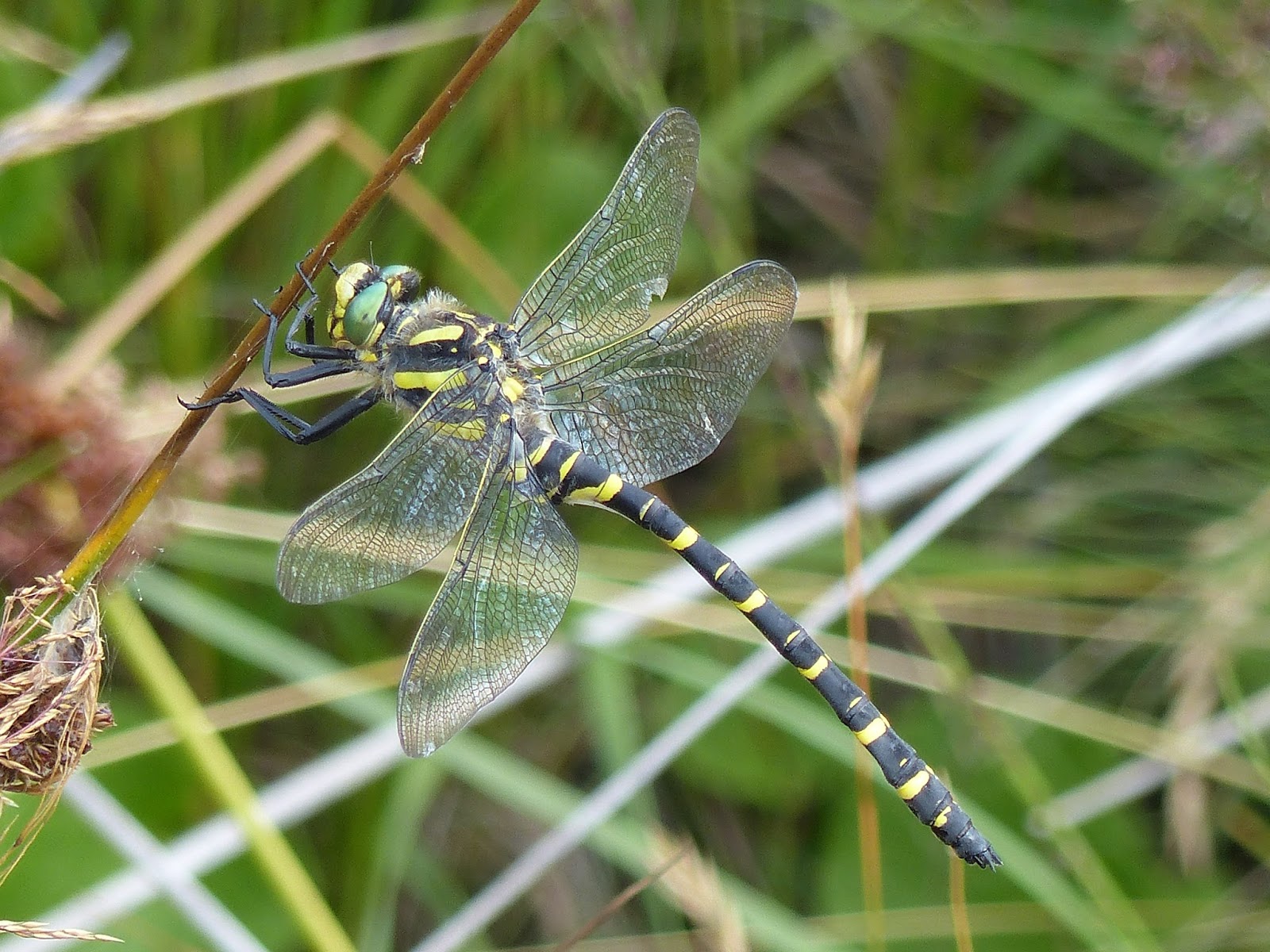
Golden-ringed Dragonfly

Now that I'm back in Derbyshire, I thought I'd have a day exploring the moorlands, looking, in particular, for a very attractive dragonfly species - the Golden-ringed Dragonfly.

The Golden-ringed Dragonfly, or Cordulegaster boltonii, is the only member of this family of dragonfly to live in Britain and it prefers to live on areas of high land in acidic rivers and streams. As a result, the larvae can take up to 5 years to develop into this stunning adult.

Golden-ringed Dragonfly (male)

The individual I saw today was a male, and it was patrolling a small section of the Bar Brook on Big Moor. I saw a female "ovipositing" in this area back in 2011. See here for details. See details on the British Dragonfly Society's website here for details of this species. 

Other dragon and damselflies seen in the area were: Large Red Damselfly, Emerald Damselfly, Common Hawker (2 males) and Common Darter.

Whilst looking for the dragonfly, I spotted several other insects, including Small Heath, Gatekeeper, Meadow Brown, Small SkipperGreen-veined and Large White butterflies. 

Male and female Gatekeepers

Birds were thin on the ground, but 2 Common Buzzards were seen, along with a couple of Meadow Pipits and a Yellowhammer

I also came across a Water Vole, and its latrine.

Water Vole

Water Vole's latrine