Showing posts with label Ispot. Show all posts

Sunday, 4 May 2014

Garden Moths - an update

I had the moth trap out again on Saturday night. When I checked it this morning (Sunday) I had 1 moth and a caddisfly!!

The only moth, however, was a new one for me and for the garden, a Brindled Pug (see here).Thanks Ispot!

Brindled Pug

Caddisfly sp
 
Other moths that have been in the trap since my last posting are: Early Thorn (4th April), Beautiful Plume (5th April) and Early Grey (18th April).

Early Thorn

Plume moth (Beautiful)

Early Grey
Moth List update:

7 - Early Thorn
8 - Beautiful Plume
9 - Early Grey
10 - Brindled Pug

Sunday, 9 March 2014

New garden moth, first butterflies of 2014 and Year List update

With temperatures rising (19 degrees today!) I decided to put my moth trap out last night, for the first time in 2014. It was on all night (7pm to 5am), and only caught 2 moths of the same species, but, at least it was a new species- Hebrew Character.

Hebrew Character
 
2 Hebrew Characters
 
This species is a common moth, which flies between March and April, so hopefully I should see a few more over the coming months. More details here. Many thanks to the people on Ispot, who identified it for me.
 
When the sun came out today I managed to see my first butterflies of the year as well. First up was a Small Tortoiseshell basking on the side of the house. The next two species; Peacock and Comma, were both seen as I walked around Yorkshire Sculpture Park this afternoon. Click here to find out more information about these species.  Last up, 1 new bird for the year was a singing Chiffchaff in the afternoon sunshine.

Year List update:
113 - Chiffchaff

Moth List update:
3 - Hebrew Character
 

Tuesday, 19 November 2013

Garden Moths and Spider Update

I had the moth trap out in the garden for a few hours on Saturday night. I only caught 4 moths, but 2 of them were new to me. The first had the amazing name of Little Brown Apple  and the second one was a very worn individual and the people on Ispot couldn't identify it with 100% certainty, but they felt it was either a Brick or a Yellow-line Quaker. Here's some photos.

Little Brown Apple

Brick or Yellow-line Quaker
 
The other two moths were a Silver Y and a Twenty-plume Moth. The new additions take my Garden Moth List to an amazing 11 species (8 macro moths and 3 micro moths)!!
 
On Sunday I noticed a spider in my bath. I managed to get it out and took this photo.
 
 
Again, the people at Ispot identified it for me as Textrix denticulata, which is a common spider often found in houses. This one is a male. More details here.

Wednesday, 4 September 2013

Three new species for Linacre

One of the best things about looking at the insects at Linacre is the fact that I keep discovering new species on just about every visit. When I say new species, obviously I mean species that are new to me, not science! As far as I'm aware no one else is recording these species, so hopefully all these new records are adding something to our knowledge of this site.

Yesterday I blogged about 2 species of butterfly that I'd seen for the first time and mentioned that there was another species that I still had to identify. I put a picture of it on Ispot with a suggested name and sure enough someone else agreed, so I can now say that the species in question was a Purple Hairstreak.

Purple Hairstreak
 
Purple Hairstreak is a species that is associated with oak woodlands, so it's no real surprise that I found one at Linacre. Unfortunately though, they spend most of their lives high in the canopy and rarely come down to the ground, so I was very lucky to spot this tatty looking individual on the floor by the middle reservoir. It's not the best photo, as I had to be very quick, before it was scared away by a marauding dog that was running towards me at the time!

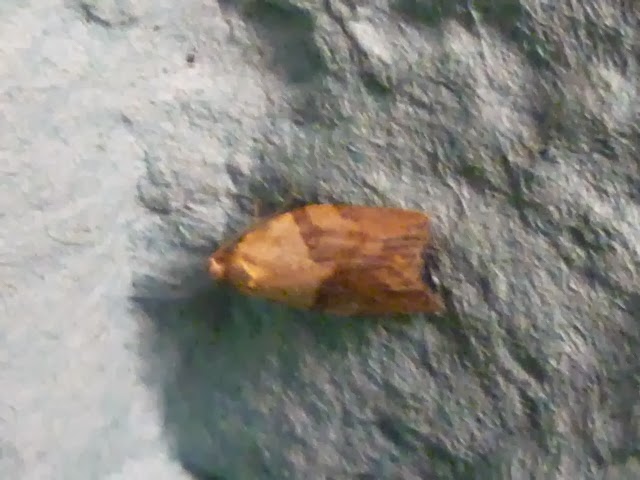
The next "new" species that I found this week was this moth. It's either a Copper Underwing (Amphipyra pyramidea) or a Svensson's Copper Underwing (Amphipyra berbera svenssoni). Unfortunately, the only way to tell the two species apart is to look at the amount of orange on the underside of the hindwing, something I didn't know, until later. Interestingly, this individual was found in the toilet block(!), but I also recorded several specimens in the bird boxes this year, so it appears to be quite a common species, whatever it is.

Copper or Svensson's Copper Underwing

Last up is this species of hoverfly that I found whilst looking for the butterflies. It doesn't have an English name, but goes by the latin name of Myathropa florea, and is the only member of this family of hoverfly in Britain. It is classed as "widespread and common" in my superb Hoverfly Identification guide. and the best way to identify it is to look at the pattern on its thorax, which is said to resemble the "Batman" logo. What do you think?

Myathropa florea

Tuesday, 25 June 2013

Linacre insects and flowers

At this time of the year the birdlife at Linacre can go quite quiet, so, whilst walking around on Sunday, I also started to look around at the flowers that are coming out and some of the insects that live on them. Some of the species I didn't recognise, so I put them on iSpot and got a few new names. Here are a few pictures.

Red and Black Froghopper
 
 
Marmalade Hoverfly
 
Red-tailed Bumblebee (Bombus lapidarius - male)
 
Early Bumblebee (Bombus pratorum)
 
Marsh Snipefly (Rhagio tringarius)
 
Marsh Orchid species
 
Common-spotted Orchid