Showing posts with label Emerald Damselfly. Show all posts

Tuesday, 4 August 2026

Little Barbrook Reservoir

 On Sunday, I had a couple of hours at Little Barbrook Reservoir. I went looking for Whinchat (no luck), Stonechat (1 family party seen) and dragon/damselflies.

Juvenile Stonechat ( 1 of 3 seen)

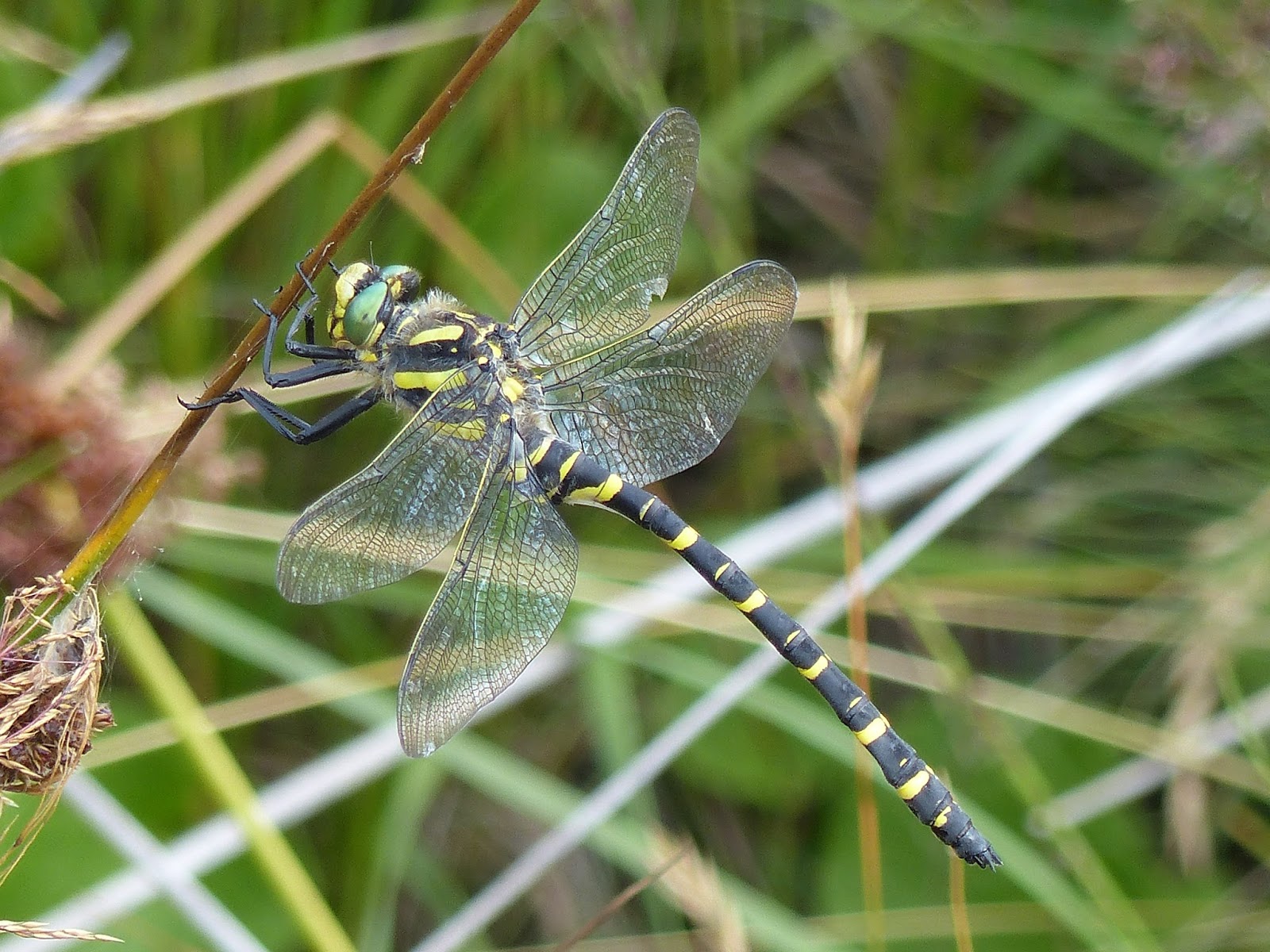
Odanata seen were: Emerald Damselfly (20+, including pairs in tandem), Black Darter (1 male) and Golden-ringed Dragonfly (2, 1 male).

Golden-ringed Dragonfly

Sunday, 27 July 2025

Big Moor Dragons - 26th July 2025

Yesterday, Jayne and I had a walk up to Little Barbrook Reservoir on Big Moor. We went to look for dragonflies, and managed to see a couple of new species for the year.

The highlight, as always, was our first Golden-ringed Dragonflies of 2025. We saw two individuals, both males, including this one that had, unfortunately, damaged its body, presumably whilst emerging. Despite this, it appeared to be doing ok, and we got very lucky, when it perched by the main path eating a wasp!

Golden-ringed Dragonfly

Undamaged male!

Other odanata seen were: Emerald Damselfly (new for year), Black Darter (1) and Common Blue Damselfly (2 males).

A few butterflies were on the wing: Gatekeeper (8), Small Heath (1) and Red Admiral (1).

Birdwise, it was very quiet, but we did manage to see a couple of Reed Buntings, Meadow Pipits, a Common Buzzard, and a single, juvenile Stonechat.

Saturday, 15 July 2023

The Gulls are Back!!

 Late this morning, I had a drive across to Rufford for the first visit since March, looking for the returning Black-headed Gulls.

I was in luck, with 20 birds (all adults) seen on the main lake, including the first darvic-ringed bird of the autumn, 293A! This bird was ringed at Center Parcs, as an adult, in December 2021, and was last seen in February 2022. No breeding season sightings have been reported, yet.

293A

Whilst there, Jayne and I had a walk around and spotted some good insects as well: Common Dater (1, my first of the year), Blue-tailed Damselfly, Emerald Damselfly (1, also my first of the year), a Hawker sp, Comma (4), Small White (10+), Red Admiral (1), Peacock (1) and Gatekeeper (1 being eaten by a female Blackcap!). We also had Swallows and House Martins over the lake.

Common Dater

Tuesday, 21 July 2020

Baslow Edge- 19th July 2020

Jayne and I had a walk from Curbar Gap up to Baslow Edge on Sunday. Bird wise, it was pretty quiet, with just the usual Meadow Pipits and a few Crows flying around, but we did enjoy some butterflies, moths and dragonflies.

We started out walk on Clodhall Lane and walked across to the small pond. Here we had a very brief view of a hawker dragonfly, possibly Common. Unfortunately, we weren't able to see it again, so couldn't clinch the id. We did, however, see a couple of Emerald Damselflies and a couple of Common Darter. Walking on from there, towards the Wellington Monument, we sat by a small stream to watch a fantastic male Golden-ringed Dragonfly that was patrolling a small stretch of water by the path. He also perched up on the rocks allowing us some superb views and  a photo.

Golden-ringed Dragonfly


The butterflies seen were Ringlet (10+), Small Tortoiseshell (3), Small Heath (5+), Red Admiral (1), Gatekeeper (1), Small Skipper (3), Large Skipper (1), Meadow Brown (5) and best of all, a Painted Lady (our first record for 2020). 

Painted Lady

We also saw 2 species of day-flying moth, 3 Narrow-bordered 5-spot Burnet Moths and a Yellow Shell.

Narrow-bordered 5-spot Burnet Moth 

Wednesday, 16 August 2017

Dragonfly and Butterfly News

Over the summer period I like to get out and about recording dragonflies, damselflies and butterflies. Recently I've added a few new species.

The first new insects were spotted last week on a walk around Cupola Ponds, Stanedge. Emerald Damselflies were very common here, along with several Common Blue Damselflies, several Common and Brown Hawkers and an Emperor dragonfly.

Emerald Damselfly (male)

Afterwards, I drove up to Big Moor, where, again, many Emerald Damselflies were flying about, including several pairs "in cop" i.e. mating. Also seen here were Common Darter (pairs in cop and newly emerged individuals), Common Hawker and a very nice Wall Brown butterfly.

Emerald Damselflies (mating pair)

The last new species were Ruddy Darter and Black Darter. The Ruddy Darter, a male, was seen on Monday at RSPB Old Moor, and the Black Darter, males, females and newly emerged, (tenerals) were seen at Little Barbrook Reservoir on Big Moor.

Ruddy Darter (male)

Black Darter (female, I think)

Black Darter (male)

Tuesday, 23 August 2016

Big Moor Year Tick

Last Thursday I spent a few hours up on Big Moor. Whilst there I added Whinchat to the "year list", with one adult and at least 3 juveniles present.

Whinchat (juvenile)

Whilst up there, I also saw juvenile Stonechat, Meadow Pipits, Skylark and 5 Red Deer.

Red Deer

Insect wise, I saw Black Darter, Small Heath, Common Darter, Common Hawker (2) and Emerald Damselfly.

Black Darter

Common Darter (female/immature)

Small Heath on Harebell

Emerald Damselfly (male)

Year List update:
166 - Whinchat

Monday, 17 August 2015

Golden-ringed Dragonfly

Now that I'm back in Derbyshire, I thought I'd have a day exploring the moorlands, looking, in particular, for a very attractive dragonfly species - the Golden-ringed Dragonfly.

The Golden-ringed Dragonfly, or Cordulegaster boltonii, is the only member of this family of dragonfly to live in Britain and it prefers to live on areas of high land in acidic rivers and streams. As a result, the larvae can take up to 5 years to develop into this stunning adult.

Golden-ringed Dragonfly (male)

The individual I saw today was a male, and it was patrolling a small section of the Bar Brook on Big Moor. I saw a female "ovipositing" in this area back in 2011. See here for details. See details on the British Dragonfly Society's website here for details of this species. 

Other dragon and damselflies seen in the area were: Large Red Damselfly, Emerald Damselfly, Common Hawker (2 males) and Common Darter.

Whilst looking for the dragonfly, I spotted several other insects, including Small Heath, Gatekeeper, Meadow Brown, Small SkipperGreen-veined and Large White butterflies. 

Male and female Gatekeepers

Birds were thin on the ground, but 2 Common Buzzards were seen, along with a couple of Meadow Pipits and a Yellowhammer

I also came across a Water Vole, and its latrine.

Water Vole

Water Vole's latrine

Wednesday, 27 May 2015

Year List Update and a new Dragonfly

This week is half term, which means I've had a bit of time to get out and about to do some birdwatching and increase my "year list". I've also added a new species of dragonfly to my "life list" with a Scarce Chaser seen.

The first new bird that I found was the Long-eared Owl. I saw this bird hunting over the moorland in the Peak District. I won't give the exact site, as it is a site where the bird has been known to breed.

The next birds, numbers 132- 138 (except House Martin, which I saw a few weeks ago, but forgot to add on), were all seen on a recent trip the RSPB Ouse Washes reserve in Cambridgeshire. I'm particularly pleased with the Short-eared Owl, Bittern (heard booming), and the Common Cranes, which are never easy to find. Whilst on site, we also saw and heard at least 2 Cuckoos, saw a Great-spotted Woodpecker feeding chicks, a fly-over Green WoodpeckerSwallows and caught up with my first dragon and damselflies of 2015, namely Blue-tailed Damselflies, Emerald Damselflies and this beautiful Scarce Chaser, which is a new species for me!!. I'm pretty sure its a young male, and, as its name suggests, its pretty scarce in the UK. See here for more details about this species.

Scarce Chaser

The final new bird is a Nightingale, which is now imposssible to see in Derbyshire. For this bird we, Jayne and I, travelled a little further south to Paxton Pits Nature Reserve. We were very lucky and managed to hear and actually see at least 2 male birds singing around the Kingfisher Hide. If you've never heard  the song of the Nightingale, listen to it here, as its an amazing sound. Whilst there, we also heard more Cuckoos, and saw a couple of males flying around the site. 

Year List update:
 131 – Long-eared Owl
132 – Common Tern
133- Common Crane
134 - Little Egret
135 – Short-eared Owl
136 – Bittern
137 – House Martin
138 – Reed Warbler
139 - Nightingale

Thursday, 15 August 2013

Wragg's Quarry Dragons

After our ringing session yesterday the sun came out and the temperatures soared to an amazing 20 degrees, so I popped up to Wragg's Quarry on Beeley Moor to search for some elusive dragonflies. I read a very good blog www.darleydalewildlife.blogspot.co.uk , which had some sightings of the two species I wanted to see, and is definitely worth a read.

Pond at Wragg's Quarry

As soon as I arrived I spotted my first species and a "lifer"; Common Hawker. This large dragonfly is very active, rarely settling for more than a few seconds, so I was very pleased when a stunning male took time out of patrolling the small pond to sit on a rock.

Common Hawker
All in all I saw at least 5 male Common Hawkers over the small pond.

The other target species for the morning was Black Darter, and again I was very lucky to catch up with several dragons including this male and female "in tandem".

Male and female Black Darter
 
This pair are mating, a process that can take from 6 - 60 minutes(!), and the male will stay attached to the female whilst she lays the eggs or "oviposits" them into the vegetation in the pond. Darley Dales Wildlife has an excellent picture of a pair doing just that here.
 
As well as the pair, I also managed to find this lone male basking on a rock, close to the water. They are non-territorial, and often spend time perched up on vegetation, rocks and bare ground. Identification is pretty straight forward, as it is the only all-black dragonfly in Britain. As can be seen here, it also has black legs, a waisted abdomen and a black pterostigma (the black patch on the wings). A lovely insect. The Black Darter's favoured habitat is shallow, acidic, nutrient-poor pools on heathland and moorlands. This makes the pond at Wragg's Quarry ideal.

Male Black Darter
 
Other dragonflies seen today were; Common Darter and Emerald Dragonfly.

Friday, 26 August 2011

Barbrook Dragons!

Every summer I like to visit a small area of moorland just off the A621 Baslow road to look for a few of my favourite dragonflies, namely Black Darter and Golden-ringed Dragonfly. The area that I call Barbrook Bridge is located by the junction of the A621 and a minor road leading to Cubar in North East Derbyshire, grid refernce SK278741.

Bar Brook Bridge

As you can see, the site is an area of moorland with the Bar Brook running through the middle of it. Just under the bridge there is a small, slow flowing pool, which then runs into a a shallow, much faster flowing stream. My visit today started at the bridge where the Black Darters as usually to be found. I say usually, because unfortuntaely I didn't find any today! What I did find, however, was this amazing spider.


Spider species

Moving further down the river I walked through the vegetation when I suddenly disturbed a large dragonfly species. It flew a short distance, before landing on the ground. I crept up and saw a beautiful Golden-ringed Dragonfly probing the ground with its rear end. I realised that this was a female egg laying or ovipositing! As I watched it I noticed that it had got its wings caught in the water, so I reached down and it crawled out of the water and sat on my hand vibrating its wings to dry off and warm up, before flying off again, when it was lost from view. What an experience!

       Golden-ringed Dragonfly

After this amazing encounter I walked up to a smaller pool where I managed to find a Common Darter, 2 male Emerald Damselflies and half a dozen "blue" Damselflies.

Common Darter


Emerald Damselfly

Apart from the dragons several other birds and insects were also  present in the area. Butterflies were Small Copper, Small Heath, Meadow Brown and my first Wall Brown of the year. 

Wall Brown


Birds present were Meadow Pipit, Linnet, Goldfinch and Blue Tit.