Showing posts with label Lapwing. Show all posts

Monday, 31 August 2026

Linacre First - Green Sandpiper!

 Before I write this blog, I need to clarify something about the title. I was at Linacre this morning, and saw MY first ever Green Sandpiper. It may not be the first ever record, as I was contacted last week by someone, who said they'd seen two there last week. Also, one of the volunteers (Pete) said he, and another volunteer (Antony) had, also seen a "sandpiper" on the top reservoir last week. Despite this, I was very pleased to get my first record.


Green Sandpiper

Other species seen were: Lapwing (8 flew in, and landed briefly - the first record since 2023, and the first to land since 2011!!!), Mallard (103), Tufted Duck (30), Mandarin Duck (20), Black-headed Gull (4 juvenile/1st winter birds), Lesser Black-backed Gull (2 adults), Moorhen (6; 5 adults and 1 juvenile), Coot (2 adults) and Cormorant (8).

Lapwings

7 of the 8 Cormorants

Sunday, 12 April 2026

Waders, Gulls, Summer Migrants and a few Ducks!

I had a few free hours yesterday afternoon, so I popped down to Ogston Reservoir to see what was about. As a member of the Ogston Bird Club, I had access to the Members' Hides.

I knew that there had been a Black-tailed Godwit around for a few days, so I was very pleased to find it feeding about 40m away from the hide. They aren't that common in Derbyshire, so to get good views was a real treat.

Black-tailed Godwit

Next up was Snipe. These are much more common than the Godwit, but the Members' Hide at Ogston can often allow you to get some pretty close views. On this visit, I saw 4 different birds, all feeding along the Moat area.

Snipe

Two other species of wader seen were: Lapwing and Oystercatcher. Both species breed on site. I managed to see three of each of these birds.

Lapwing

Oystercatcher

Along with the waders, were four species of gull: Black-headed Gull, Herring Gull, Common Gull and Lesser Black-backed Gull.

Lesser Black-backed Gull

Black-headed Gull

Ducks seen were: Teal, Gadwall and Mallard, including a female with 11 ducklings (my first of the year).

Mallard

Last, but not least, were the newly-arrived summer migrants. Swallows, Sand Martins and a single House Martin were all seen.

Friday, 4 July 2025

Butterfly Update

 Over the last week or two I've been out and about looking for a few new summer butterflies.

The first were seen at Barbrook Pools (formerly Barbrook Reservoir) last Sunday, when the 2 Small Coppers, Large Skippers and Narrow-bordered 5-spot Burnet moths were present. Whilst there, I was also able to confirm breeding for Tufted Duck (female and 8 ducklings) and Lapwing (1 adult and 3 chicks).

Narrow-bordered 5-spot Burnet

Tufted Duck 

The next butterflies seen were at Lindrick Dale, yesterday. Overall, numbers were well down on previous years (possibly due to the very warm spring?), with just 4 Dark Green Fritillaries, 6 Marbled Whites, 4 Gatekeepers, 1 Ringlet and about half a dozen Small Skippers seen. 1 other species, Silver-washed Fritillary, was also seen flying around the woods, on the walk through.

Monday, 3 April 2023

RSPB Winterbourne Downs - 2nd April 2023

 Jayne and I have had a few days down in Wiltshire, visiting a few new sites and  seeing some nice birds.

Our first new site was RSPB Winterbourne Downs, which is a great spot to see Stone Curlews. We popped across on Sunday, and managed to see a couple of birds. Also on site were; Lapwing, Linnet, Green Woodpecker, Red Kite, Buzzard and Brown Hares. Whilst there, we also spotted a Comma butterfly, and a "Flifer" - a new species of fly (thanks for the new word Jayne!), Dotted Bee Fly.

Dotted Bee Fly

Year List Update: 105 - Swallow, 106 - Green Woodpecker and 107 - Stone Curlew.

Thursday, 19 August 2021

Pacific Golden Plover and Black Stork!!

 Yesterday I had a drive over to RSPB Frampton Marsh to see a couple of nice birds: Pacific Golden Plover (lifer!) and Black Stork (British tick).

The Pacific Golden Plover was very easy to see, as it fed for the whole visit on a small piece of water on the marsh, about 20m from the sea wall. I got excellent views via the 'scope and even managed a half decent photo.

Pacific Golden Plover

The Black Stork (a juvenile) wasn't quite so easy, as it was at in a ditch about a 45 minute walk from the car park when I arrived! I walked across, however, and got great views of it on the ground, and then several more throughout the day as it flew around the reserve.

Black Stork

Other birds seen around the reserve included Redshank, Spotted Redshank, Ruff, Black-tailed Godwit, Dunlin, Little Ringed Plover, Green Sandpiper, Spoonbill (17), Black-headed Gull, Grey Heron, Swallow, Canada and Greylag Geese, Little and Great-crested Grebe, Teal, Wigeon, Gadwall, Mute Swan and Goldfinch.

Year List update:
162 - Pacific Golden Plover
163 - Black Stork
164 - Green Sandpiper
165 - Spoonbill
166 - Spotted Redshank

Sunday, 23 April 2017

Birthday Lifer

It was my birthday this weekend, so I travelled up to Teesdale and RSPB Bempton Cliffs with my family for a couple of days. High on my wish list was a bird that I've looked for before - Black Grouse. This year luck, and a bit of research, paid dividends, and I got to watch an amazing 22 males and 19 females at a lek site in Upper Teesdale. The birds were seen (and heard) from the road, with the birds about 500m away. After the lekking was over, a female bird and 2 males flew closer to me, allowing a couple of reasonable shots from the car.

Black Grouse (female)

Black Grouse (male and a Curlew)

Driving back down to our hotel in Barnard Castle I managed a couple of lovely photos of 2 other moorland birds; Lapwing and Snipe.

Lapwing

Snipe

Other birds seen in Teesdale were: Red Grouse, Common Sandpiper (1 on the Tees in Barnard Castle), Dipper, Grey Wagtail, Curlew, Swallow (5) and Red-legged Partridge (year tick).

After Teesdale, we drove across to Bempton Cliffs in North Yorkshire, and added another 4 species (Razorbill, Puffin, Gannet and Kittiwake) to the "year list", taking me to 141. It was pretty windy when we got there, and the Gannets, in particular, were hovering just on the edge of the cliffs, and dropping down onto the grass to grab mouthfuls for  their nests, allowing some decent photo opportunities.

Gannet

Other species seen here were: Guillemot, Tree Sparrow, Skylark, Fulmar and Herring Gull.

Year List update:
136 – Black Grouse
137 – Red-legged Partridge
138 – Razorbill
139 – Puffin
140 – Gannet
141 – Kittiwake

Friday, 14 April 2017

Big Moor Year ticks

Jayne and I had a couple of hours on Big Moor this afternoon. It was pretty blustery, but we walked from the road up to the old reservoir and back again, adding 2 new species to the "year list".

The first species seen was Wheatear, with 2 male birds seen on the fence posts by the house by the reservoir.

Wheatear

The other "year tick" was Red Grouse, with 2 birds seen flying over the moor. Other species seen were: Kestrel (1 hunting by the house), Peregrine Falcon (1 flew over), Meadow Pipit (10+ flying around and singing), Skylark (6 flying and singing), Lapwing (5 displaying), Canada Goose (2 birds on the pools), Curlew (1 heard), Carrion Crow (3), Reed Bunting (1 male) and Linnet (2 birds flew over).

Year List update:
132 - Wheatear
133 - Red Grouse

Tuesday, 25 October 2016

Common and Jack Snipe

I spent a few hours at RSPB Old Moor in Barnsley today. Whilst there I spent the majority of the time watching Common and Jack Snipe from the Family Hide.

There were at least 7 Common Snipe on show, including 1 that fed in the grass in front of the hide. I managed to get some nice shots and a little video (see here).

Snipe

The Jack Snipe was also present in front of the hide for a short while, before flying off to island number 7, where it spent the next few hours. I didn't get any photos whilst it was near the hide unfortunately, but I did manage to get a few "digiscoped" efforts thanks to Amanda from the Chesterfield RSPB Group, who was at Old Moor volunteering. Thanks Amanda! Here's a shot of both species side by side for comparison.

Jack Snipe (back bird) and Common Snipe

Jack Snipe (left hand bird) and Common Snipe

Other birds seen from the hide included Wigeon, Teal, Gadwall, Mallard, Pochard, Coot, Mute Swan, Moorhen, Shelduck, Pied Wagtail , Kingfisher, Black-headed, Lesser Black-backed  and Common Gulls.

Friday, 10 June 2016

Derbyshire Red Kite

Last night, following a text from my nephew, Luke, I spent a very enjoyable couple of hours watching a Red Kite at a site in North Derbyshire. I won't say where it was, because, as we all now, there are many people out there who find the thought of any type of predator in the countryside a very unwelcome thing, and would be quite happy to see it gone! Suffice to say, the bird has been present in the same area for at least 3 days, perching on fence posts, walls and feeding on the ground. This is only my second ever Derbyshire record. Hopefully, there will be many more in the future.

The bird never came very close. It was about 500m away when I arrived, sitting on a fence, and only moved to about 300m in the 2 hours I was there. In fact, out of the 2 hours I was watching the bird, it spent about 1 3/4 hours sitting round, and about 15 minutes feeding. Here are a few, heavily cropped photos.


Red Kite

Other birds seen in the area included this Pied Wagtail, 2 Curlew, 2 Lapwing, Yellowhammer (male heard singing), and Linnets. The Red Kite record was sent to the Derbyshire Ornithological Society.

Pied Wagtail

Thursday, 3 September 2015

RSPB Old Moor

I had a day at RSPB Old Moor today in search of a Great White Egret, that has been present for a few weeks. After a few hours, and quite a few "near misses" I managed to connect with the bird when it flew out of the reeds on Wath Ings and disappeared onto nearby Bolton Ings. in total, I saw it for about 30 seconds, so no photo I'm afraid!!

While waiting for the egret, I got another "year tick" in the shape of 2 Common Sandpipers that were feeding close to the hides. Other waders present were: Green Sandpiper (2), Dunlin (4), Ruff (4), Snipe (1), Lapwing (c.300), Golden Plover (3 breeding plumaged birds) and Black-tailed Godwit (3).

Common and Green Sandpiper

Green Sandpiper

As well as the waders there were a good number of ducks, geese and swans present including: Mallard, Gadwall, Pochard, Wigeon, Teal, Mute SwanCanada and Greylag Geese.  

Shoveler

Last but not least were the small birds. I didn't see or hear many, but the highlights for me were dozens of Goldfinch, a single Marsh Harrier, 8 Swallows and 2 Swifts, which are my latest ever record.

Year List update:
167 - Great White Egret
168 - Common Sandpiper

Saturday, 14 February 2015

North East trip adds to the Year List

Although the weather wasn't great yesterday, we decided to have a trip to the coast. We decided on Tynemouth near Newcastle, as this meant we could also combine the beach and some shopping with a little birding too.
 
The day started in Tynemouth itself, where we had a walk along the beach. During the walk we spotted the first "year tick" of the day with a Rock Pipit, feeding along the sea wall. Walking up to castle and Priory we spotted a large, female Peregrine Falcon carrying a Feral Pigeon. She perched up on the cliff side after being harassed by the local Herring Gulls, and then flew off south with her lunch. Also flying around the headland here were a couple of Fulmars. Here's a heavily cropped photo of the Peregrine.

Peregrine Falcon

After a spot of lunch at the café on the beach, we drove up to St Mary's Island, where we spent a hour looking at the waders and managed to add a few more birds (numbers 74 - 82) to the list. As well as these birds there were also about 50 Lapwings, 100+ Starlings and a superb flock of at least 500 Golden Plover flying around the area. Unfortunately, the tide was low, so I wasn't able to find any Purple Sandpipers today.
 
Here's a photo of one of the Ringed Plovers that was feeding around the causeway.
 
Ringed Plover
 
Year List update:
71 – Rock Pipit
72 – Peregrine Falcon
73 - Fulmar
74 – Redshank
75 – Turnstone
76 – Oystercatcher
77 – Curlew
78 – Sanderling
79 – Dunlin
80– Ringed Plover
81 – Eider Duck
82 - Shag

Saturday, 17 January 2015

Great Grey Shrike - Beeley Moor

Great Grey Shrikes appear in Derbyshire most winters, and one has been reported on the Birdguides website since December, so I decided to go up to Beeley Moor this afternoon with Jayne to see if we could catch up with it.

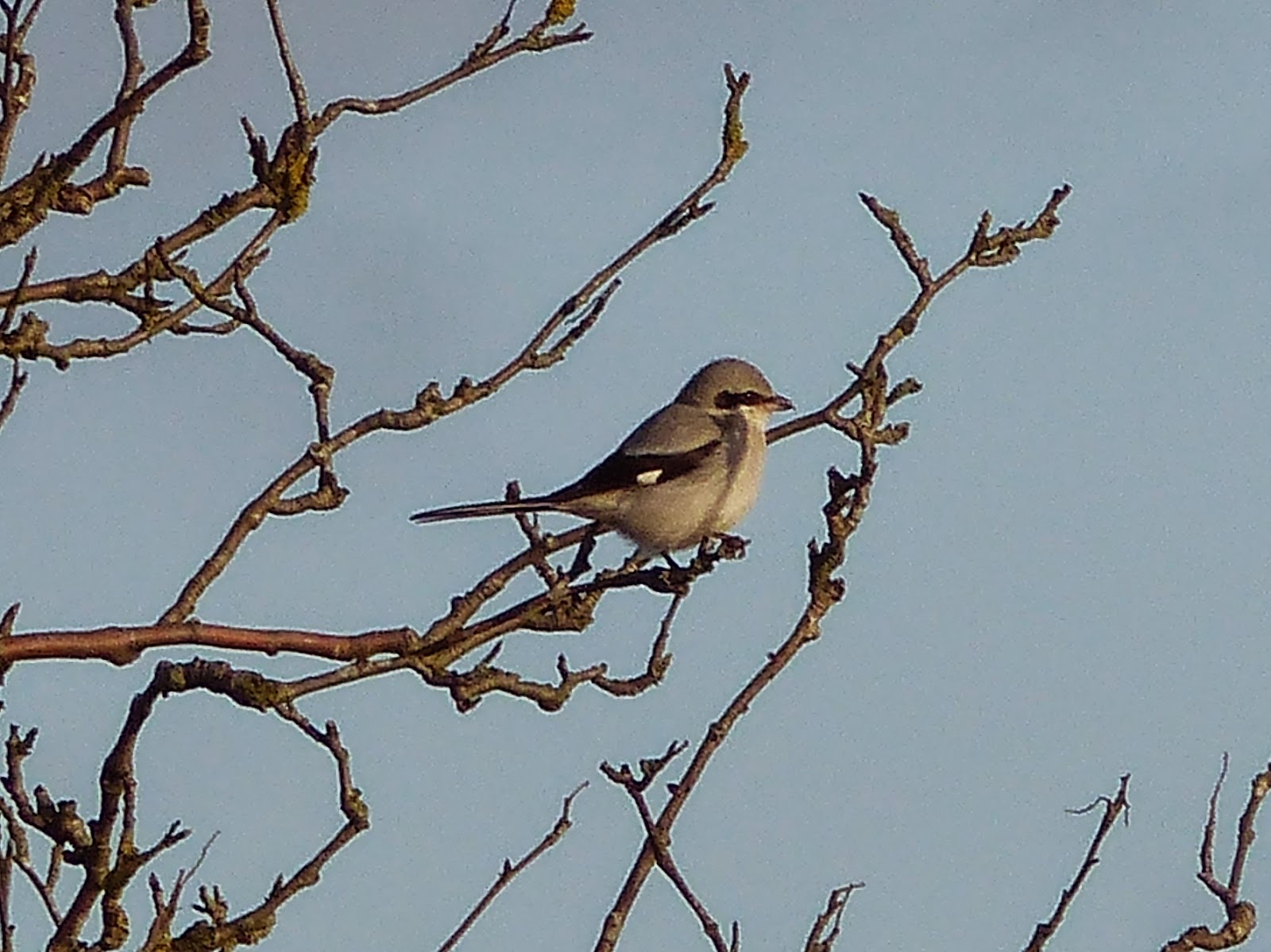
As you can most likely tell from the blog title, we dropped lucky and managed to watch the bird hunting around fields by Sitches Plantation. It was a little too distant for any great photos, but I did manage to get a half decent record shot.

Great Grey Shrike

Whilst in the area I also managed to add another 2 species to the "year list"; Lapwing and Golden Plover, both of which were present in the area in good numbers (approx.200+).

Year List update:
57 – Great Grey Shrike
58 – Lapwing
59 – Golden Plover

Sunday, 8 December 2013

Storm damage and duck counting at Linacre

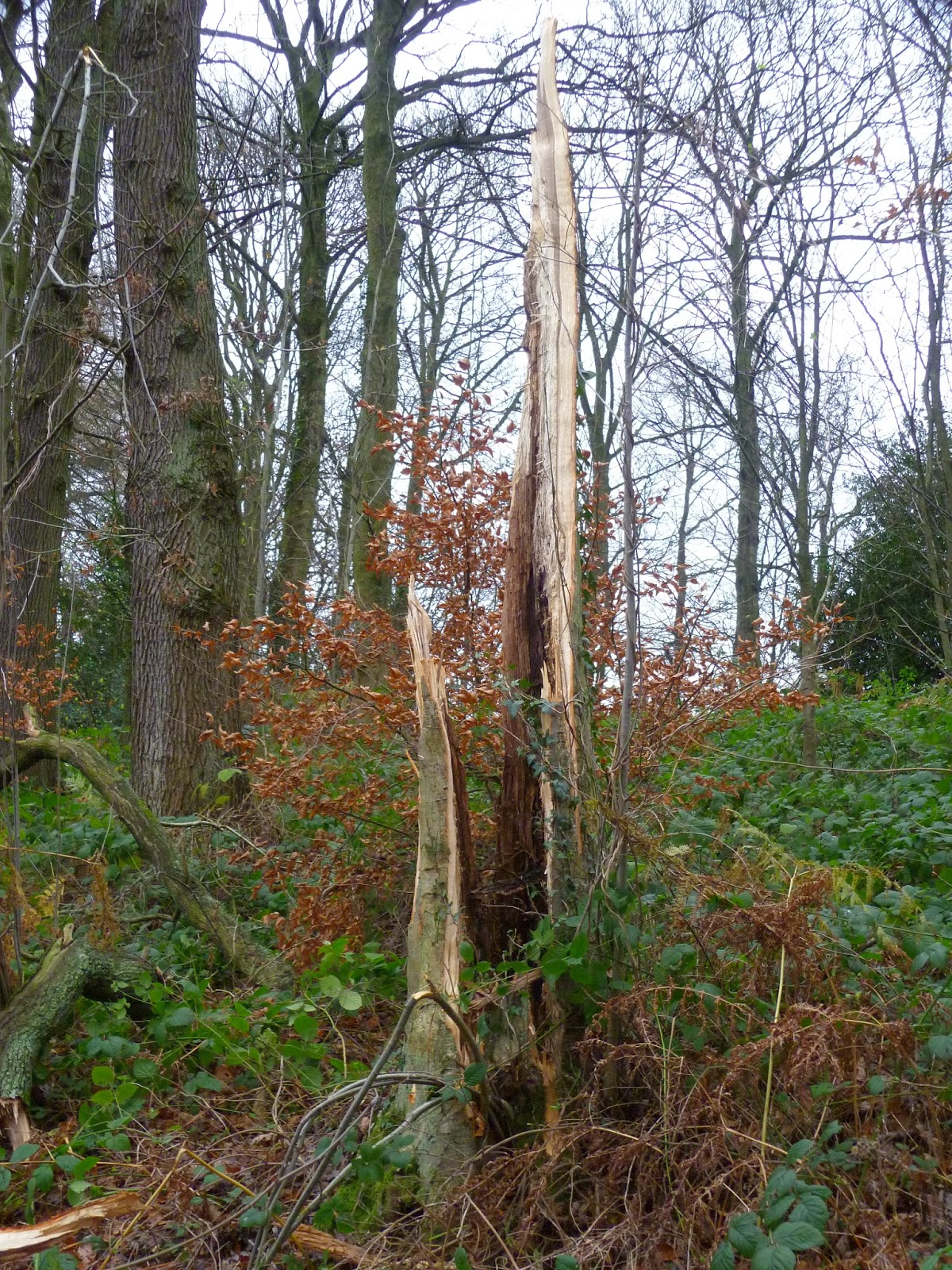
Following the heavy winds last week I was interested to see whether the woods at Linacre had suffered much damage. Luckily, the answer was "no", with just a couple of branches down and this tree by the bottom reservoir.
Storm-damaged tree
 
New stump!
 
I walked around all three reservoirs this morning, hoping to see last week's colour-ringed  Black-headed Gull (TC30), but the birds that were there today (just 31), were being fed by some kindly dog walkers, which meant they were flying around and not perching on the walls, so I couldn't see if s/he was there.

Luckily for me, however, the reservoirs were very busy with other birds today and I managed to count 135 Mallards and 60 Mandarins, which were both the highest counts of the year so far. Also present were: 12 Coots, 8 Moorhens, 1 Little Grebe, 1 Grey Wagtail, 55 Tufted Ducks, 1 Kingfisher (on the middle reservoir), 1 Grey Heron, 3 Cormorants and a great flock of c60 Lapwings, that were flying over the top reservoir for about fifteen minutes (only the second record of 2013).

Lapwings (63 I think. Please feel free to count)

 
 Other sightings were Starling (7 flew over the top reservoir), a hunting Kestrel over fields by the top reservoir, Redwings and Fieldfares, Siskins and a small group of Crossbills (c12), which were feeding in the larches by the middle reservoir.

Saturday, 19 October 2013

Winter visitors arrive and patch tick

No ringing today because of the wet and windy weather early on, so instead I went off to Linacre for 3 hours walking around all 3 reservoirs.

Most notable of all was the number of  Redwings that were flying over. They were heard all morning and several were feeding on the Rowan berries around the reservoirs. Also present today were Fieldfare (18 flying over were the first of the winter), the single Wigeon on the middle reservoir (here for the winter?), 6 Lapwing that flew over the top reservoir, 1 Pied Wagtail, at least 10 Crossbills (over the Rangers' Base and then over the top and middle reservoirs) 1 Sparrowhawk over the top reservoir and fly-over Meadow Pipits and Skylark.

Out on the water itself were Mallard (92), Tufted Duck (39), Mandarin Duck (27), Grey Wagtail (1), Kingfisher (flew from the willows by the boardwalk on the top reservoir), Great-crested Grebes (2), Little Grebe (6 on the bottom reservoir), Cormorant (1) and Black-headed Gull (15).

The patch tick mentioned in the title was a record of a Shelduck from the Sheffield Bird Study Group, that was seen on Friday (17th). I've never seen one at Linacre, but, according to David, who keeps the records for the group, there have been records back in 1998 and 2004. As these dates are before I started recording I've included it here as a patch tick. Hope that's make sense!!

No bird photos today, instead I've got a slug and some fungi for you.

slug sp


fungi

Friday, 31 August 2012

Old Moor - 31st August 2012

News of a Red-necked Phalarope at RSPB Old Moor yesterday got my "twitching instinct" going and so I drove over for a few hours this morning. Unfortunately the bird had departed overnight, so no new tick this time!

Instead of looking at the phalarope I spent time scanning the hundreds of Lapwings to see what I could see. 4 Black-tailed Godwits were feeding from Wath Ings hide along with 2 Ruff, 12 Golden Plover (many still in summer plumage), 7 Green Sandpipers and 1 Greenshank. A few more waders were present over on Wader Scrape Hide, namely Common Sandpiper and Ringed Plover.

Away from the birds I managed to see and photo a few nice insects: Common Darter, Ruddy Darter and Meadow Brown.

Meadow Brown
 
Common Darter pair
 
Ruddy Darter (note the black legs and waisted abdomen)


Wednesday, 15 August 2012

RSPB Old Moor- 13th August 2012

I had a trip over to RSPB Old Moor on Monday with my nephew and niece. We managed to see a good range of birds and insects and I added 2 new species to my Year List; Greenshank and Green Sandpiper.

Greenshank

The first hide we went into was Wath Ings at the far end of the reserve. At this time of year the water levels are dropped and there is a large area of mud, perfect for the many passage waders that are passing through. It was here that we spotted a total of 9 Green Sandpipers and a couple of Greenshanks as well as dozens of Lapwings,  up to 8 Grey Herons, Tufted Duck, Mallard, Canada Geese and the first Teal and Wigeon of the winter!

Next stop was the Wader Scrape hide, where a large flock of Goldfinch and Linnet were feeding, and 5 Common Terns, including a juvenile bird, were flying about.

Linnet


Walking back to the centre we spotted a few dragonflies including Common and Ruddy Darter.

Common Darter

Before going home we decided to have a go at pond dipping and look at the birds on the feeding station. We spotted a juvenile Great- spotted Woodpecker on the peanuts and managed to catch a Diving Beetle and some type of dragonfly larvae, posssibly a hawker species.

Great-spotted Woodpecker

Diving Beetle

Dragonfly larvae

Year List:

150 – Greenshank
151 – Green Sandpiper