Sunday, 27 April 2014

Linacre Nestboxes - another update

The weather this morning wasn't good enough for using the mist nets for ringing (too windy), so we decided to check the owl boxes and the Little Owl tree at Linacre instead.

We started at the box where we'd had a Tawny Owl on our last visit (see here). The good news was that the owl was still present.The not so good news was that the box was empty, with no sign of any chicks. On our last visit we didn't see a chick, but the fact that the adult bird didn't move when we approached made us quite confident that she was incubating. We also saw eggshell below the box last time, so whether there ever was a chick, and what has happened to it we just don't know. Next year perhaps?!

After this disappointment. we went to check the other 3 owl boxes. 1 contained Grey Squirrels again, 1 was empty - again, but the final box delivered with a female Mandarin Duck on a clutch of 9 eggs. Unfortunately we couldn't catch her like we did last year (see here), so we don't know whether she was the same bird again or a different bird. Details of the nest will be entered into the BTO's Nest Record Scheme.

Mandarin clutch
 
The last stop of the morning was the Little Owl tree, where we ringed an adult and one pullus last year ( see here and here). Unfortunately (again), although we'd seen one bird in the tree on the way in, when we checked the nesting hole, it was empty. We checked around the tree, and noticed a much smaller hole with a feather stuck on it, so it seems they've "moved house" this year. As I said, the entrance to this site was much smaller than last year's site, and we were unable to look in to see if any eggs had been laid, so no chance of ringing any birds this year.

On a more positive note, when I got home, I checked the House Sparrow terrace that's on the side of my house and found this:
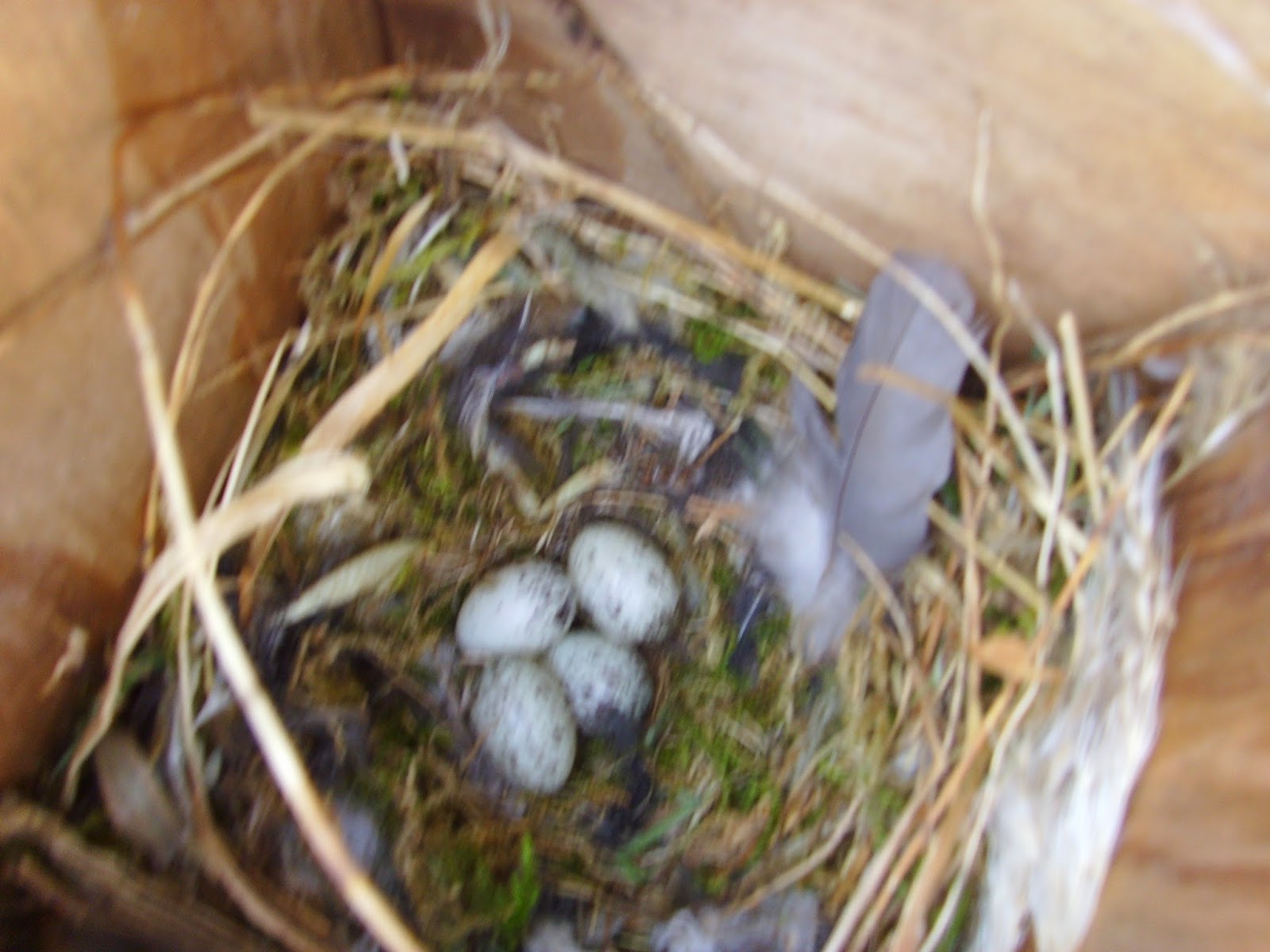


This is only the second time sparrows have used the box, so I'm keeping everything crossed for a successful outcome. Details of the eggs have been entered into the BTO's Nest box Challenge programme.

Saturday, 26 April 2014

Yellow Wagtails at Carsington

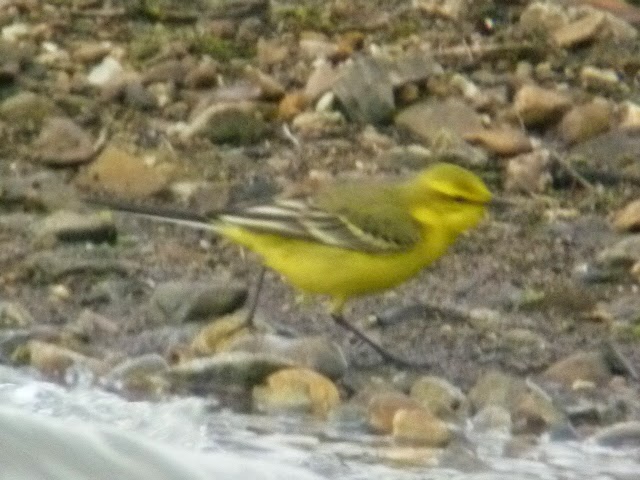
This time last year I went up to Carsington Water to see some passage Yellow Wagtails. I've been checking Birdguides all week, and spotted a few reports coming through, so I drove across tonight and managed to locate 3 very bright individuals on the Water Sports Island. Here's a couple of photos.


Yellow Wagtail
 
Also seen on this island were a Common Sandpiper,  a Redshank and an Oystercatcher, whilst flying around were dozens of Swallows, and a couple each of Sand and House Martins.
 
Year List update:
140 – Yellow Wagtail
141 – Common Sandpiper

Friday, 25 April 2014

Year List update

I've had a chance to "tick" a few birds over the last couple of days, so I thought I'd update the old "Year List" with the new additions.

The first two species; Stonechat and Pied Flycatcher, were both seen last night at the National Trust's Padley Gorge. The Stonechats, a pair, were seen on the moor side at the top of the gorge, whilst the Pied Flycatcher, a male, was heard singing in the woods and seen visiting one of the nest boxes.

When I got home, I looked at the sightings page of the Sheffield Bird Study Group, and saw that a Grasshopper Warbler had been heard "reeling" at the pond on the nearby Longshaw Estate, so I popped across this morning to pick it up. I arrived at 6.30am, and heard it straight away. Afterwards I went down to Linacre to check the nest boxes, and saw my first House Martin of the year.

Year List update:
136 – Stonechat
137 – Pied Flycatcher
138 – Grasshopper Warbler
139 – House Martin

Linacre Nestbox Update- 25th April 2014

After my first check of the bird boxes at Linacre 10 days ago, I thought it was about time I went around again, so I set off this morning to see what was going on.

Three hours later I'm back home with some good news. Of the 87 tit boxes on site, 26 had active nests with eggs, an occupancy rate of 29.8%, which is about average. The number of eggs in the boxes ranged from 1 to 12, and all appeared to be either Blue or Great Tit.

Blue Tit incubating

Clutch of 12 eggs!!!

There was only one box with an adult sitting, (Blue Tit), and none of the other eggs were being actively incubated, so most of the clutches were incomplete. Given an  incubation period of about 14 days, the first chicks should be hatching in mid May, and be ready for ringing a week or so later. I was on my own today, so I didn't check the owl/Mandarin boxes. All the boxes checked will be entered into the BTO's Nest Record Scheme.

Away from the boxes, the site was quite quiet today, with most of the resident birds appearing to have settled down to breeding as well. Both Great-crested Grebe nests are still being incubated, as are the Moorhen and Coot nests.

As far as migrants are concerned, there were about 10 Swallows over the top reservoir, along with my first House Martin of the year. Willow Warblers, Chiffchaffs and Blackcaps were also singing around the site, but no sign of any Pied Flycatchers yet.

Wednesday, 23 April 2014

Norfolk Highlights

Just back from a couple of days in Norfolk, where I visited a couple of good reserves and added 17 species to the "Year List".

First stop was the Norfolk Wildlife Trust's Weeting Heath reserve. This heathland reserve is the place to see Stone Curlews, and we were lucky to see a pair from one of the hides.

Stone Curlew

After seeing the curlews, we drove across to RSPB Titchwell on the north Norfolk coast and spent 2 hours walking around, where we added another 16 new species for the year. Highlights here were a pair of Bearded Tits, breeding  plumaged Spotted Redshank and Grey Plover and a booming Bittern.

Grey Plover

Year List update:

119 – Stone Curlew
120 – Brent Goose (Dark-bellied)
121 – Red-crested Pochard
122 – Bearded Tit
123 – Spotted Redshank
124 – Greenshank
125 – Common Scoter
126 – Common Tern
127 – Bittern (booming)
128 – Little Egret
129 – Sand Martin
130 – Little Ringed Plover
131 – Grey Plover
132 – Knot
133 – Bar-tailed Godwit
134 – Sedge Warbler
135 – Cetti’s Warbler

Sunday, 20 April 2014

"Commic" Terns at Linacre

Since I started recording the birdlife at Linacre Reservoirs began back in 2006 I have only ever had 1 sighting of any tern species, a single Common Tern. This morning's WeBS walk started well, with the first waterbirds seen being a couple of "commic" terns flying over the bottom reservoir. Commic Terns aren't a new species, but the name given by birders, to birds that can't be positively identified as either Common or Arctic Terns. Unfortunately I only saw them for about 30 seconds, before they flew off east down the valley, so today's birds fell into that category. Looking on Birdguides later, I noticed that there had been a big influx of Arctic Terns into the country, so its quite possible that these birds were Arctics, but as I didn't identify them as such at the time they'll have to stay as "commics".

After the excitement of the "commics" I carried on and walked around the site to carry out the rest of this month's WeBS count. Usually, at this time of the year, water bird numbers  drop off, as birds disperse to breed. This was the case today, but there were a few surprises in store as well.

First the expected birds: Mallard (43; including 2 broods of ducklings, two groups of 7), Tufted Duck (22), Canada Goose (1, the hybrid bird), Coot (10, including the incubating adult on the top reservoir), Moorhen (7, including the incubating bird ,also on the top reservoir), Great-crested Grebe (4, 2 pairs, both incubating eggs), Mandarin (2 males) and Grey Wagtail (1 heard only).

A little more unexpected were the "redhead" Goosander that was on the top reservoir, and a summer plumaged Black-headed Gull. Both species are regular winter visitors, but have normally left by now, so both sightings were noteworthy. Another species, Oystercatcher, was reported yesterday (thanks Jim), and was the first sighting of 2014. Again, this is a very uncommon species at Linacre, usually only recorded as flying through in the spring time, presumably "on passage", so all records are interesting.

As well as the water birds, the noteworthy birds today included the first 2014 report of Swallow (2 over the middle reservoir, about a week later than last year), a Little Owl, a calling Tawny Owl and singing Blackcaps (6), Chiffchaffs(8) and Willow Warblers (3).

Carr Vale Ringing - 19th April 2014

I was out ringing yesterday morning at The Derbyshire Wildlife Trust's Carr Vale Reserve with my trainer and 3 other members of Sorby Breck Ringing Group. We arrived at 06.00hrs, hoping to trap and ring a few summer migrants. By the end of the morning we had caught 25 birds, which included 3 Chiffchaffs and a couple of Blackcaps.

One of the Chiffchaffs was a retrap, a bird that we had caught before, and it turned out to be a bird that we had first caught last July at Carr Vale. Interestingly, the bird had been caught by Alan last year, and he also "processed" it today. It would be great to know where it had spent the winter. Southern Europe perhaps, or even further south??

Another bird that was very interesting this morning was a female Reed Bunting.


This bird was identified as a female by the presence of a brood patch, but, as you can see from the above picture, it had a great deal of black on the face. which is more normal in a male bird (see here for typical male and female birds).  Apparently there is evidence that some female Reed Bunting's colouring  becomes more "male-like" as they get older, but this bird was aged as 5, i.e. born last year, so what's happening is a bit of a puzzle. That's the joy of ringing, always lots more questions than answers!!