Sunday, 29 April 2012

Farm Survey Walk - 28th April 2012

Yesterday saw me out and about for  the first survey of the year as part of the RSPB's Volunteer and Farmer Alliance scheme. Each year I'm given a different farm and asked to survey the birdlife three times over the breeding season. These results are then sent to the farmer along with advice about how to encourage any that are missing or how to improve the number of those present. Especially important are those classed as being of conservation concern e.g. Yellowhammer, Grey Partridge and Skylark.

This year's farm is in North Notttinghamshire and consists of mainly arable land (oil seed rape and peas), as well as a couple of fields with cows and horses and an area of newly planted woodland.

One of the inhabitants.

This being the first visit and quite early on in the season meant that a total of 26 species was quite respectable. Included in this list were a few "red listed" birds, i.e. those of highest conservation concern, including singing Reed Bunting, a pair of Grey Partridge, Yellowhammer, Skylark, 3 Lapwing and about a dozen Linnet.

Male Reed Bunting

A few summer migrants were around and singing (Chiffchaff, Willow Warbler, Blackcap and a single Swallow), but hopefully when I visit again in about a month's times there should be a few more in. Other, more unusual species, were a pair of Gadwall on the fields with the cows and 4 Greylag Geese.

Sunday, 22 April 2012

Birthday Birding

It being my birthday today I managed to get a lot of birding in. Many thanks Jayne!

First stop was Linacre where, in 2 hours, I recorded my first Greylag Geese for this site this year, with 2 on the top reservoir. They normally appear for a week or two in April, but so far, they've never stayed and bred. Perhaps this year?

Greylag Goose

4 Blackcaps were singing, as were 5 Chiffchaffs and just 1 Willow Warbler. Unfortunately, there was no sign of any Pied Flycatchers today. They do appear to be late this year. Finally, the Mistle Thrushes were feeding 3 big young in their nest. I managed to get some video footage through my 'scope, so I'll try and upload it to the site.

Next stop was RSPB Old Moor, where hundreds of Black-headed Gulls have begun nesting.

Black-headed Gulls at Old Moor


Other birds seen here included: Gadwall, Shoveler (1 male), Mallard, Mute Swan, Little Grebe, Avocet (1), Lapwing, Redshank, Cormorant, Tree Sparrow, Blue Tit, Willow Warbler and Chiffchaff.

The final site of the day was Burbage Moor, where I hoped to find a Ring Ouzel.

Burbage Moor

Unfortunately my luck had run out, but I did manage to see a couple of female Wheatear, Meadow Pipits, at least 4 singing Willow Warblers and an over-flying Raven. Very nice!

The Year List has moved on by 3 species today:

123 – Shoveler
124 - Avocet
125 - Wheatear

Saturday, 21 April 2012

Two ringing ticks

Another brilliant ringing session this morning, this time in Sheffield, saw me add 2 new species to my "ringing list" with my first Blackcap ( a female) and a Nuthatch ( a male).

Nuthatch

Blackcap (female)

As well as these two species I also managed to ring or retrap the following: Blackbird (1 retrap), Great Tit (1 retrap), Dunnock (1 retrap), House Sparrow ( 1 new bird).

Evidence of breeding activity included many birds with "brood patches", including this Great Tit and a Dunnock seen depositing faecel sacs from young in an unseen nest.

Great Tit with brood patch

Other species ringed or retrapped by the group today were: Tree Sparrow, Robin, Chaffinch, Greenfinch, Yellowhammer and Blue Tit. Swallows were flying around the site, but evaded the nets.

A Mistle Thrush was present around the site singing, and did get in the nets at one point. Unfortuntaely he managed to get out again, before we got to him- drat!

Sunday, 15 April 2012

Linacre - First tit eggs of the year!

Spent three hours down at Linacre this morning in glorious sunshine and a temperature of 2 degrees!  I popped down to catch up with developments in the nest boxes and to see what was happening with the thrush nests. As you can imagine there was a mixture of good and bad news!

First the good news. Out of all the boxes checked a total of 10 had eggs in them. No adult birds were seen during the visit and the eggs were all cold and unattended which is the norm before the entire clutch has been laid. Number of eggs ranged from 2 to 6, so there is obviously time for the birds to lay more eggs. All the eggs seen today looked like Blue or Great Tit eggs.

First eggs

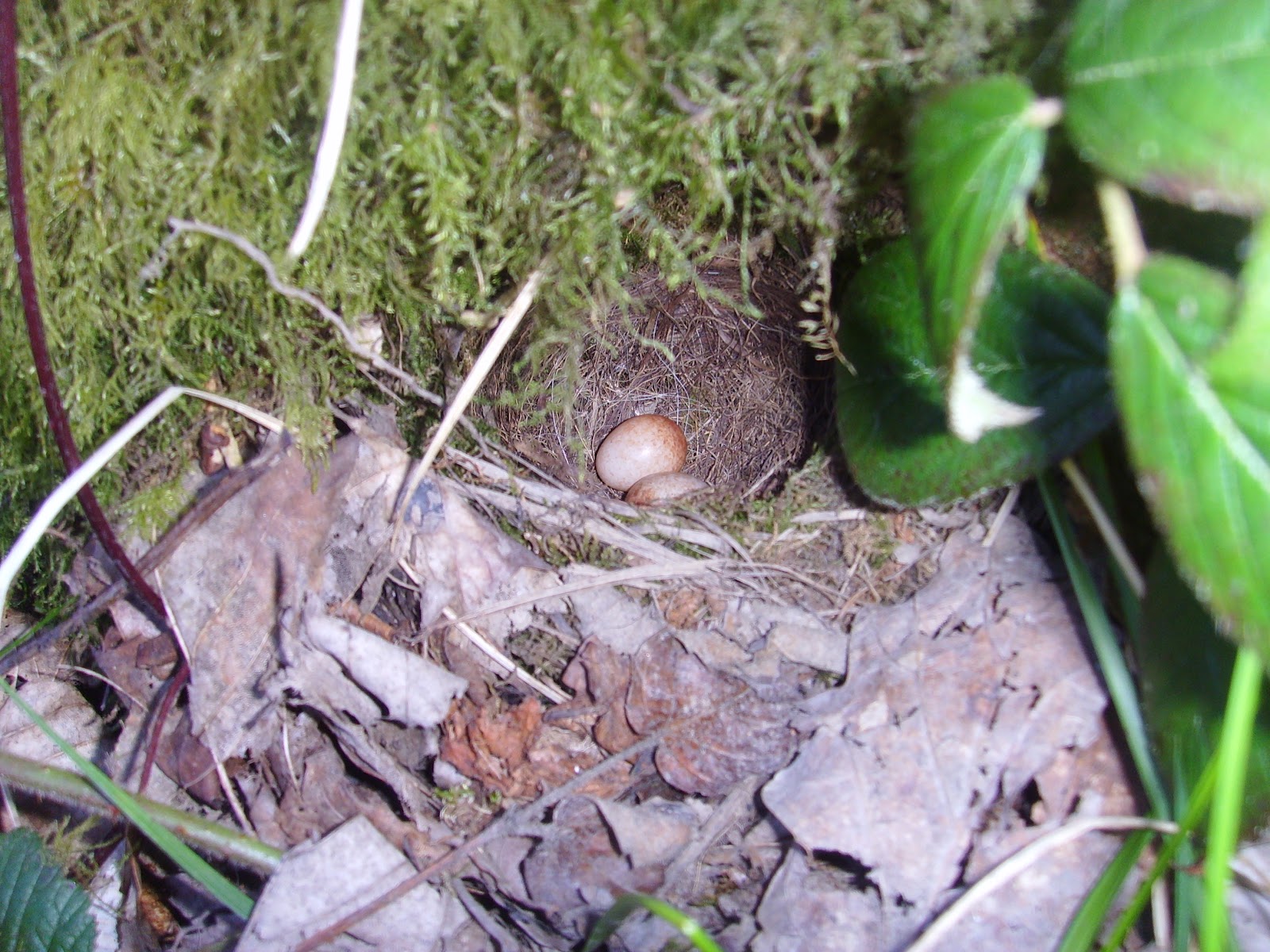
As well as checking the nest boxes I also stumbled (literally) on this nest containing 3 eggs.

Wren's nest?

As I walked past it, a tiny, brown bird flew out and disappeared. My initial thought was Wren, especially as the nest was located on the floor under the roots of a tree. I moved away quickly, but I didn't see the adult bird again. When I checked in my nest guide book the eggs looked right for Wren, but the nest should have been lined with feathers. Apparently though the male bird will build several "cock's nests" and the female chooses one and lines it herself. Perhaps she's started laying and will line it later? That's the joy of nest finding - there's always something new to learn. I'll return next week to see if it's still there and to see if it's been lined. Meanwhile I'll start a new nest card for the BTO's Nest Record Scheme.

As I said at the start of the post there was good and bad news today. More good news was that the Mistle Thush was still sitting tight on its nest, the Great Crested Grebes have started building again, now that the water level has risen again, but unfortuntaely the Song Thrush nest I found a few weeks ago has failed. I checked it ealier this week and it contained 1 egg, but today it was empty and the adult bird was nowhere to be seen - presumably predated!

Song Thrush nest with 1 egg

Away from the eggs and nests I also managed to spot a few birds! The highlights today were my first Swallow, Sand Martin and Willow Warbler at Linacre this year. There were about a dozen Swallows flying low over the top reservoir with just 2 Sand Martins in amongst them. I'm particularly pleased with them as they are my first here since 2006! A Curlew was also heard, my second record of the year, and a pair of Grey Wagtails were present on the top reservoir. Last but by no means least was the small party of Lesser Redpoll in the Larch trees, the singing Blackcap (at least 3 around the reservoirs) and the 2 calling Green Woodpeckers, again my first here since 2010.

Saturday, 14 April 2012

Thrybergh CP - Ringing and 2 Year Ticks

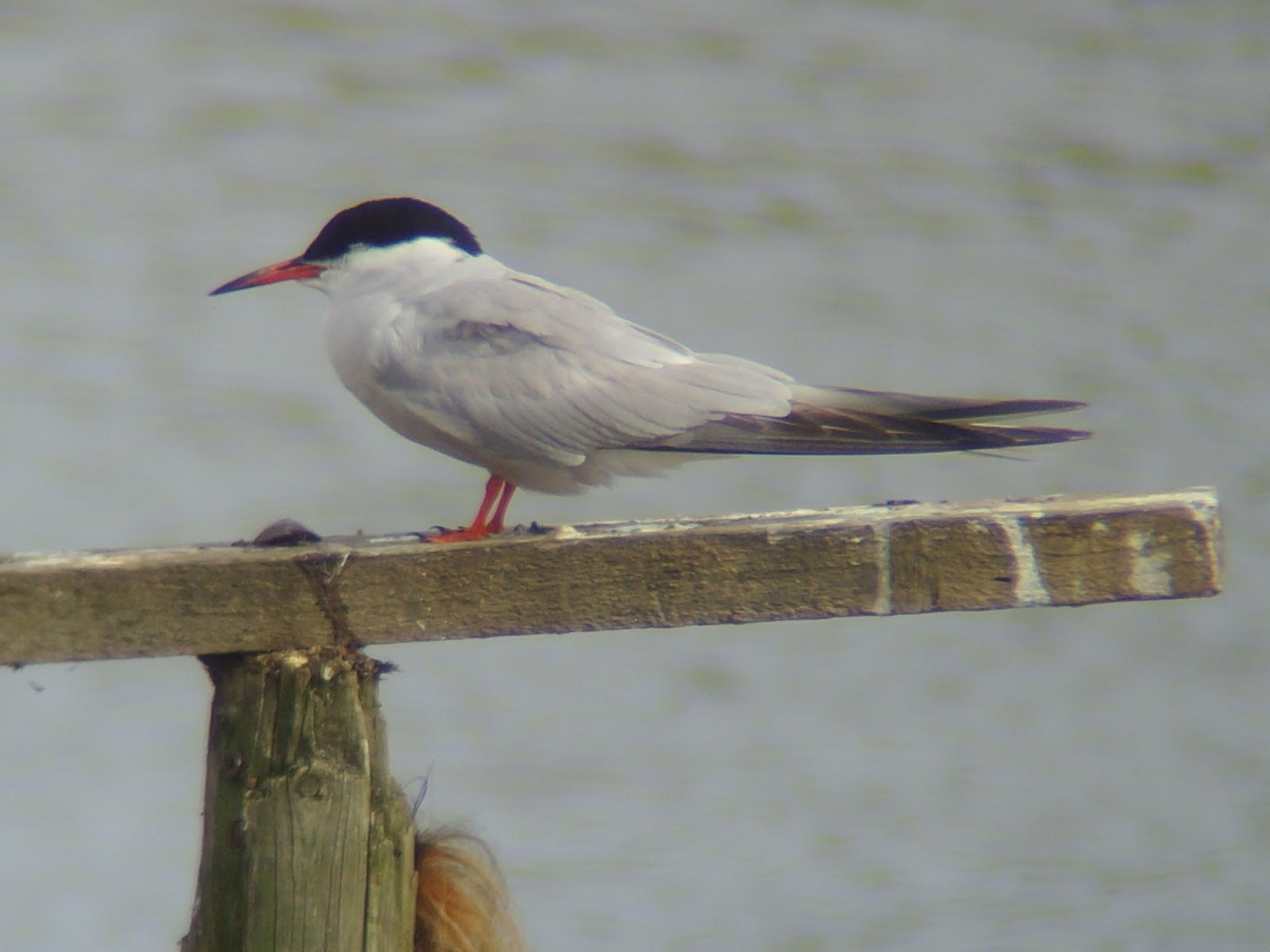
Today started very well with a great ringing session at Thrybergh Country Park in Rotherham. As well as the best catch for a while (17 birds) I also got two year ticks with my first Willow Warber and Common Terns of the year.

Common Tern (note the black tip to the bill)

The ringing began at 7.30am, a nice time to start, and within a few minutes we had our first birds in the net. The birds continued throughout the morning and by the time we packed up I had rung my first Tree Sparrow of the year, my second Yellowhammer, my third Chaffinch and had a retrapped Dunnock.

In between net rounds we spent some time looking at the birds on the lake which included 40 odd Sand Martins, several Swallows, 1 House Martin ( which I didn't see, so I'll wait to add it to my Year List), Cormorants, Mute Swans, Mallards, Canada and Greylag Geese, at least 1 pair of Gadwall (my first record here), Coots, Moorhens and singing Skylarks (over the fields, not on the lake!).

One bird that had us scratching our heads was a possible "White Wagtail" that was seen feeding on the edge of the water. Although not yet a species in its own right, it's the european version of our Pied Wagtail, it's a regular passage bird in Britain and is very nice to see. As regards the identification, it's back was very grey, but what worried us was the lack of  a clear division between this and the black head. I consulted "Collins" (the best field guide ever, buy a copy if you haven't already got one) when I got home and apparently a female White Wagtail shows a "diffuse transition black to grey" i.e. the neck of the female bird is greyer and blends into the grey of its back! If only I'd taken my camera with me!!!! The jury's still out on this bird, but here's a picture of a male White Wagtail seen on Stones Island, at Carsington Water, Derbyshire, last year.

White Wagtail

The Year List moves on 2 species:

121 - Willow Warbler
122 - Common Tern

UPDATE: After a little emailing and a lot of help from a David from the ringing group (thanks David), I think I'm pretty happy to i.d. this morning's bird as a female White Wagtail. If you're interested, follow this link to read a very intersting paper explaining why.

Thursday, 12 April 2012

Carsington Water - 4 Year Ticks

Hi there. Had a trip up to Carsington Water today and managed to bag myself 4 Year ticks- hurrah.

First up was a Great Northern Diver that has been present thoughout the winter. What's really nice now though is that it's moulting into summer plumage and is beginning to look very smart.

Great Northern Diver

To see what one looks like in full summer plumage take a look at this link. The next year tick of the day was quite a surprise when 6 Black-tailed Godwits were found feeding around Horseshoe Island. This bird is an uncommon passage migrant in Derbyshire, so I was very pleased to see them, especially as 2 were in full summer plumage already. I managed to get a distant record shot, but again, this link will show  just how pretty they are.

sleeping Black-tailed Godwit

The next year tick is a bit of a cheat because it is Barnacle Goose. It's a cheat because the birds at Carsington are part of a feral population that have been present for several years after escaping from a collection. "Real" Barnacle Geese migrate to Britain in the winter before leaving and breeding in the High arctic.

Barnacle Geese

Last but by no means least was the 4th year tick of the day - Swallow. The first birds were seen flying over Stones Island and then approximately 12 were seen feeding low over the reservoirs. Amazing to think that these birds have just arrived back from a winter spent in South Africa! Hopefully I'll be able to ring my first Swallows this year and I may even get a control from Africa. That would be good!

The year list moves on:

117 – Great Northern Diver
118 – Black-tailed Godwit
119 – Barnacle Goose
120 - Swallow

Other birds noted today were: Chiffchaff, Blackcap, Dunnock, Robin, Blackbird, Black-headed Gull (several pairs settling to breed), Common Gull (1 asleep with the BH Gulls), Oystercatcher (1 pair), Redshank, Coot, Moorhen, Mallard, Canada Goose, Pied Wagtail, Mute Swan, Tufted Duck, Teal (1 pair).

Wednesday, 11 April 2012

5 out of 6 ain't bad!

RSPB South Stack on Anglesey, North Wales, is a wonderful clifftop reserve which has thousands of Guillemots, Razorbills and Puffins breeding every year. In addition, it also has a very special bird, the rarest member of the crow family, namely the Chough.

Lighthouse at South Stack, Anglesey


My family and I visited South Stack yesterday whilst staying in Llandudno. We managed to see 4 Choughs flying over the reserve and feeding in nearby fields. I got some shots, but they were all pretty awful due to the distance away and the wobbly 'scope.

Chough (note the red beak)

As well as the Choughs we also got superb views of several Ravens, Linnets, Goldfinch, Herring, Lesser Black-backed and Great Black-backed Gulls, but no auks at all!!Apparently the windy conditions of late had made go back out to sea. Hopefully they'll return when the weather settles down.

Raven (note the diamond shaped tail).

Jayne and Lydia spotted their first Swallow of the year, but I missed it as I was looking at the Choughs. Hopefully I'll catch up with a Swallow this week at Linacre.

As well as seeing Choughs and Ravens I also managed to see 3 other members of the crow or corvid family today, namely Jackdaw, Rook and Carrion Crow. The only one missing was a Jay!

The Year List moved on by 1 species:

116 - Chough